The Bee: Amazon’s AI Wearable Buzzes with Professional Promise, But Raises Personal Privacy Hives
The landscape of personal technology is constantly reshaped by artificial intelligence, and a recent engagement with Bee, Amazon’s acquired AI wrist gadget, offered a tangible glimpse into this evolving future. Since its integration into the Amazon ecosystem, Bee has undergone significant updates, positioning itself as a compelling, albeit complex, contender in the burgeoning wearable AI market. This device aims to transcend traditional smartwatches, offering an always-on AI assistant designed to capture, organize, and synthesize our daily interactions.
The Rise of the Ubiquitous AI Assistant
At its core, Bee functions as a sophisticated personal assistant, leveraging advanced AI to record, transcribe, and summarize spoken conversations throughout the day. This provides users with an unprecedented, ongoing note-taking capability, invaluable for those seeking enhanced organization or simply a reliable memory aid. Furthermore, its ability to synchronize with a user’s digital calendar transforms it into a proactive assistant, delivering timely alerts and reminders, ensuring users remain on schedule and informed. The strategic acquisition by Amazon underscores the industry’s belief in the pervasive potential of such integrated AI solutions, signaling a future where personal AI companions are seamlessly woven into the fabric of our daily lives.
Seamless Integration and Core Mechanics
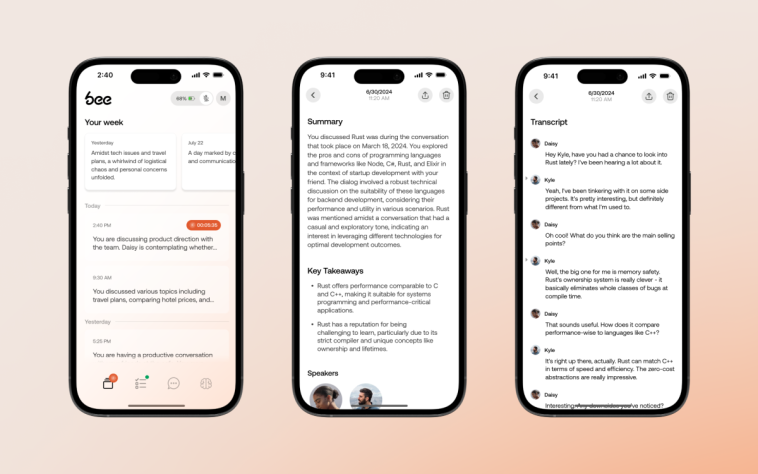
Operating Bee is designed for intuitive ease. Users simply power up the device, secure it to their wrist, and complete a straightforward synchronization process with the accompanying Bee mobile application, inputting essential personal details. The wearable features a discreet, built-in recorder, activated or deactivated with a single button press. A subtle green light serves as a clear visual indicator when recording is active, providing immediate feedback to the user. Post-recording, the Bee app efficiently processes the audio, generating both a comprehensive transcription and an easily digestible summary of the conversation. This streamlined workflow exemplifies the push towards frictionless technology, where complex AI operations are hidden behind user-friendly interfaces.
Navigating the Privacy Paradox
The very concept of a constant listening device strapped to one’s wrist invariably ushers in a profound discussion around privacy. As digital surveillance becomes an increasingly inescapable aspect of modern life, the prospect of an “eavesdropping gizmo” can trigger significant apprehension for privacy advocates. This tension between unparalleled convenience and the desire for personal space is a critical challenge for the entire AI wearable industry. For many, the idea of ambient recording, even for personal benefit, necessitates a careful weighing of its utility against potential infringements on personal autonomy.
Unlocking Professional Efficiency
Despite initial privacy reservations, Bee undeniably demonstrates significant potential within specific contexts, particularly in professional environments. For individuals whose days are packed with meetings, calls, and information exchanges, Bee could prove to be a remarkably competent digital aide. Its ability to meticulously document and distill conversations offers a powerful tool for enhanced productivity and information retention, mitigating the perennial challenge of managing a deluge of daily details.
During a recent business call, I activated Bee after securing explicit consent from the other party. The device faithfully processed the conversation, delivering a concise summary that thoughtfully segmented key discussion points. This feature proved undeniably helpful, allowing for efficient review without the need to re-listen to the entire recording. While existing services like Otter or Granola offer similar transcription and summarization capabilities, Bee’s wearable form factor provides a distinct advantage, offering a more integrated and always-ready solution that can seamlessly flow with a professional’s dynamic schedule, transforming the way we capture and recall vital information. Imagine project managers or consultants navigating multiple client engagements; a continuously running Bee could capture every nuance, offering an invaluable audit trail and knowledge base.
The Road to Refinement: Transcription and Contextual Understanding
While Bee excels at summarizing, the raw transcriptions it generates can sometimes be less refined. Earlier critiques have pointed out the common necessity for manual speaker identification, as Bee doesn’t always accurately differentiate between participants. During my test, I also noted minor omissions in the transcription, suggesting that while the summary was robust, the verbatim record might require further accuracy enhancements. These are common hurdles for early-stage AI transcription, which will likely be overcome with more sophisticated natural language processing and voice recognition algorithms, potentially incorporating biometric voiceprints for more accurate speaker attribution.
Intriguingly, Bee showcased a nascent but promising capability for contextual understanding during a casual movie night with friends. Despite the cacophony of a Quentin Tarantino film, the wearable demonstrated a surprising awareness, correctly discerning the context and labeling the ensuing summary “Tarantino Film Scene Analysis.” This indicates the AI’s evolving capacity to not just record words, but to interpret the surrounding environment and activity, a crucial step towards genuinely intelligent assistance. As AI progresses, such contextual awareness will be paramount, enabling wearables to differentiate between professional discussions, personal conversations, and entertainment, adapting its functionality accordingly.
The Intrusive Nature of Personal Data Collection
While Bee’s professional utility is clear, its proposition for personal use presents a more complex ethical dilemma. The company’s marketing often positions Bee as a personal life organizer, yet achieving this level of integration demands expansive mobile permissions. This includes access to location data, photos, contacts, calendar, and mobile notifications. Furthermore, users have the option to share health data, from sleep patterns to heart rate, accumulating a vast digital footprint.
This extensive data collection, predominantly stored in the cloud, naturally raises significant privacy concerns for the digitally vigilant. The notion of a device having such deep access to both offline and online personal life necessitates an extraordinary level of trust. A glimpse of a potential solution emerged when Bee demonstrated a version of the device capable of running entirely locally, processing data on-device rather than in the cloud. Such a development would be a game-changer for privacy-conscious consumers, offering a compelling alternative to cloud-based processing. However, Amazon has yet to provide an update on the availability or progression of these plans, leaving a significant question mark for those prioritizing data sovereignty.
Security Assurances and Corporate Realities
Bee, through Amazon, asserts a robust commitment to digital privacy, implementing encryption for data both at rest and in transit. The company’s privacy policy outlines “technical and organizational security measures designed to protect the security of any personal information” and claims to undergo “rigorous third-party security audits” alongside continuous security monitoring. While these assurances are standard and sound in principle, it’s worth acknowledging that even industry giants like Amazon, despite their vast resources, have faced data security incidents. For a company managing a substantial portion of the global cloud infrastructure, maintaining an impeccable security record is an immense, ongoing challenge, and users must factor this reality into their trust equation.
In essence, Bee stands as a fascinating piece of hardware. With further refinement and strategic development, its professional applications could revolutionize how we manage information and productivity. However, its suitability as an omnipresent personal assistant remains contentious. For many, the profound implications of an always-on AI companion, coupled with its extensive data collection requirements, might prove to be a bridge too far for personal comfort, underscoring the ongoing tension between technological advancement and the fundamental human right to privacy. The future success of AI wearables will ultimately hinge on their ability to deliver both unparalleled utility and uncompromised user control over personal data.
#TrendingNow #Innovation #TechLife #DailyMotivation #FitnessGoals #TravelAdventures #FoodieLife #FashionStyle #ArtisticVibes #MindfulnessMatters #SustainableLiving #BookLovers
Artificial Intelligence, Cloud, Data Science