

The rapid ascent of artificial intelligence is fundamentally reshaping industries, economies, and the very fabric of professional life. As AI tools become increasingly sophisticated and pervasive, the demand for a workforce fluent in its complexities has skyrocketed. This societal shift is driving a profound transformation in higher education, as institutions race to equip students with the essential knowledge and skills to navigate — and indeed, lead — this new frontier.
Christian Vivas, a 38-year-old with a successful career spanning over 15 years in photography, video production, and more recently, as an AI strategist, exemplifies this pivotal moment. Recognizing the imperative to deepen his understanding, Vivas has returned to Miami Dade College to pursue a bachelor’s degree in AI. His journey underscores a growing realization: true mastery of emerging technologies necessitates a foundational understanding of their underlying principles.
## The Exploding Landscape of AI Education
Vivas is not alone in this strategic educational pivot. A significant surge in AI-focused academic programs is underway across the United States. Today, at least 70 U.S. colleges offer dedicated AI majors, with a further 90 providing AI minors, according to data from Northeastern University. This represents a dramatic expansion from just five years ago, when only five institutions offered such majors, as reported by The New York Times. This rapid proliferation reflects a concerted effort by academia to meet an unprecedented industry demand for AI-literate professionals.
The statistics paint a clear picture of this educational boom. Thirty-two schools have recently graduated classes with at least 100 students holding AI-focused degrees, indicating a robust and growing pipeline of talent entering the workforce. This surge isn’t merely a trend; it’s a structural response to a global economic shift where AI competency is becoming a core requirement for innovation and competitiveness.
## Navigating the Educational Frontier
For universities, the challenge lies in striking a delicate balance. They must rapidly update curricula to integrate the latest breakthroughs in a field advancing at breakneck speed, while simultaneously imparting the durable, foundational concepts that will remain relevant long after current tools and techniques evolve. This pedagogical tightrope walk is crucial for ensuring graduates possess not just current skills, but also the adaptability for lifelong learning.
Maria Flynn, President and CEO of Jobs for the Future, a nonprofit dedicated to workforce issues, emphasizes this point, noting that AI degrees are most valuable when they deliver transferable skills rooted in real labor market value and a strong foundational component for continuous learning. This perspective highlights the need for a curriculum that transcends mere tool proficiency, fostering a deeper comprehension of AI’s theoretical underpinnings and ethical implications.
## Foundational Learning in a Dynamic Field
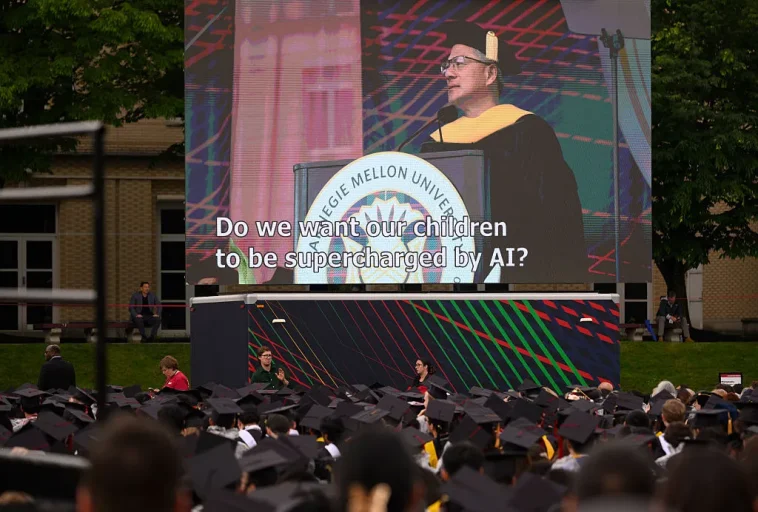
Carnegie Mellon University, an alma mater of Jensen Huang and a pioneer in the field, set a precedent in 2018 by becoming the first U.S. university to offer an undergraduate degree in AI. Its curriculum is deliberately anchored in mathematics and statistics — the bedrock upon which neural networks, machine learning algorithms, and other advanced AI constructs are built. This emphasis ensures students grasp the core mechanics, rather than just the surface-level applications.
Reid Simmons, a professor at Carnegie Mellon’s Robotics Institute, explains that while new neural network architectures constantly emerge, the fundamental principles of incremental learning based on data remain constant. By mastering this core mathematics, students are better equipped to understand and adapt to any new technology that emerges. This foresight ensures graduates are not merely operators of current AI systems but are poised to innovate and shape future advancements.
## Agility in Academia
The pace of AI innovation demands exceptional agility from academic institutions. Even at Carnegie Mellon, professors like Simmons admit they didn’t fully anticipate the sheer scale of AI’s recent expansion. Consequently, the university continuously adds and updates courses for its 120 undergraduates in the program, reflecting an ongoing commitment to currency. The challenge is stark: a course on an advanced AI topic can become partially outdated even before it concludes.
However, this dynamic environment is not entirely unfamiliar to computer science departments. Chris Callison-Burch, an AI professor at the University of Pennsylvania, notes that rapid technological evolution is a constant in computer science. He recently overhauled 40 percent of his natural language processing course to incorporate the significant breakthroughs in large language models, demonstrating the continuous adaptation required to keep pace with the field’s relentless progress.
## The Evolving AI Job Market
Despite the academic surge, the outlook for the broader labor force remains complex and, in some sectors, unsettled. Recent graduates in computer engineering and computer science have faced some of the highest unemployment rates across all majors, according to the latest data from the Federal Reserve Bank of New York. While the bank doesn’t track AI degrees separately, this trend raises concerns about the entry-level job market.
A prevalent worry among undergraduates is that the entry-level roles traditionally found at major tech companies like Google or Amazon could now be automated by advanced AI agents. This concern underscores a shift in the nature of work, where routine tasks are increasingly delegated to machines, prompting a need for human workers to focus on higher-order, more creative, and strategic functions.
## Future Implications and Beyond
Despite these anxieties, a sense of optimism pervades the long-term outlook for AI graduates. Carnegie Mellon’s experience offers reassurance: nearly all graduates interested in an AI career have found roles at leading companies such as OpenAI, Google, and ByteDance, while others pursue advanced degrees or diverse professions. This suggests that a robust AI education provides a versatile foundation.
Professor Callison-Burch shares this optimism, anticipating robust demand for individuals with strong AI and computer science backgrounds. He posits that while the job market may look different from previous generations, with opportunities spread across a much broader range of employers beyond just big tech, the overall need for these specialized skills will only intensify. The future workforce will require individuals who can not only build and maintain AI systems but also critically evaluate their impact, design ethical frameworks, and innovate human-AI collaborative solutions across virtually every sector imaginable. This ongoing demand ensures that a deep understanding of AI remains one of the most valuable assets in the professional landscape.
#TrendingNow #ExplorePage #ViralContent #InstaDaily #MotivationMonday #TechTrends #TravelGram #FoodieLife #FashionStyle #FitnessJourney #PositiveVibes #Innovation
Artificial Intelligence, Generative AI, Cloud
