The Invisible Revolution: Teleoperation Reshaping Global Industries and Labor
In the heart of China’s Xinjiang region, home to the world’s most extensive potassium sulfate deposits, a critical component of global food security, the act of packaging this vital fertilizer has long presented a formidable challenge. Vast warehouses storing the mineral are often engulfed in such dense, caustic dust clouds that human operators of heavy machinery are forced to navigate by pure tactile intuition. This hazardous environment, largely invisible to the human eye, epitomizes a global dilemma: how to perform essential industrial tasks safely and efficiently in extreme conditions.
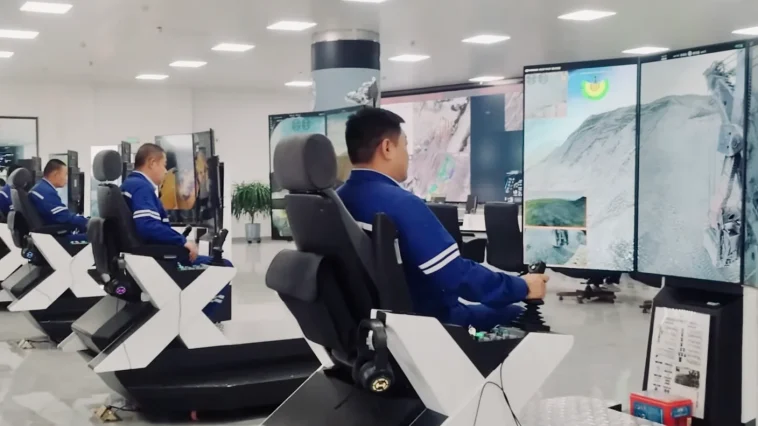
A groundbreaking solution is now emerging from the confluence of advanced robotics and telecommunications: teleoperation. Pioneered by innovators like BuilderX Robotics, this technology is redefining the interface between human skill and machine power. By enabling operators to control heavy machinery remotely from safe, comfortable offices—equipped with high-definition visual feeds that cut through environmental obscurants and intuitive, game-like controls—teleoperation not only removes workers from danger but also introduces unprecedented operational flexibility. Requiring only robust 5G or satellite connectivity, this paradigm shift is poised to become a transformative force across the global economy, extending far beyond the dusty confines of a fertilizer plant.
The Dawn of Remote Control: Teleoperation’s Ascendance
The concept of teleoperation—the remote control of physical machines by human operators—is rapidly transitioning from theoretical promise to practical application across diverse sectors. Its impact is already palpable in commercial and industrial settings worldwide. In Japan, for instance, a network of over 300 convenience stores leverages robots for shelf restocking, with these mechanical assistants often monitored and occasionally piloted by human operators situated remotely in the Philippines.
Similarly, forward-thinking transportation hubs are embracing this innovation. Düsseldorf Airport, a major European gateway, was set to trial teleoperated shuttles driven by remote personnel in May, showcasing the technology’s potential to revolutionize public transport and logistics. Beyond logistics, the security industry is also being reshaped; an Atlanta-based startup now deploys robot security guards, managed and guided by remote staff, to patrol and protect various premises. Perhaps most remarkably, the medical field witnessed a significant milestone last summer when a French surgeon successfully performed a teleoperated surgical procedure on a patient located thousands of miles away in India, demonstrating the profound implications for healthcare accessibility and specialized interventions.
Unlocking the Planetary Labor Market
While the widespread offshoring of teleoperated roles is not yet a routine practice, its potential to fundamentally reshape global labor markets is undeniable. Professor Mark Graham, a leading expert in internet geography at the University of Oxford, urges close attention to this burgeoning technology. He posits that teleoperation represents a powerful new vector for companies to amplify their long-standing strategy of outsourcing jobs to regions offering more competitive labor costs.
Graham highlights that the concept of remote work itself is not novel. However, teleoperation dramatically broadens the scope of outsourcing, extending its reach to tasks previously deemed “stubbornly local”—jobs inherently tied to a specific physical location. This technological leap means that a much wider array of skilled and semi-skilled work can now be integrated into a truly planetary labor market. Such a shift inevitably invites intense pressures related to labor arbitrage, stringent operational control, and increasing job fragmentation, consequences for which societies and economies may be ill-prepared.
BuilderX Robotics: A Vision for Safer Operations
At the forefront of this industrial transformation stands BuilderX Robotics, a Chinese tech firm rapidly establishing itself as a global leader in teleoperation for heavy machinery. The company embodies the profound shifts poised to redefine traditional industries. Founded in 2018 by Shaolong Sui, a Stanford mechanical engineering alumnus, BuilderX emerged as a direct response to escalating labor shortages plaguing the construction sector across Asia.
Sui acutely recognized that the scarcity of skilled operators was not merely a challenge for developed nations but a pervasive issue, particularly in China, where younger generations increasingly shun the hazardous and physically demanding nature of traditional construction work. Diverging from the prevailing industry trend towards full robotic autonomy, which often grapples with immense complexity and cost, Sui strategically identified teleoperation as a more immediate and pragmatic pathway to relocating human operators from dangerous worksites to secure environments. Leveraging the burgeoning availability of affordable sensors and the rollout of 5G connectivity at the time, BuilderX rapidly developed a prototype in 2019. Today, the company offers teleoperation solutions for a comprehensive suite of 14 industrial machines, encompassing excavators, loaders, and bulldozers, underscoring its pivotal role in the industry’s evolution.
Elevating Worker Conditions and Accessibility
Shaolong Sui’s vision for BuilderX Robotics is deeply rooted in a humanitarian imperative: to significantly enhance the working conditions for manual laborers globally. His frequent emphasis on extracting operators from inherently dangerous worksites underscores a fundamental belief that “these workers deserve a better life.” The transformation offered by BuilderX’s teleoperation workstations is striking, effectively converting strenuous industrial roles into a more sedentary, white-collar experience, complete with amenities like tea and coffee break rooms.
This shift delivers tangible lifestyle benefits, as Sui illustrates, allowing individuals to enjoy comfort during their shift and return home clean. Beyond safety, teleoperation significantly broadens the potential workforce. The intuitive, game-like interfaces of BuilderX’s systems enable construction firms to hire individuals previously excluded from such roles, including senior citizens and people with disabilities, thereby promoting greater inclusivity. A compelling anecdote highlights this transformation: a Japanese woman operating an excavator remotely proudly displayed intricate nail art, a luxury she recounts as impossible to maintain when performing her duties directly in the field. This not only enhances individual well-being but also addresses broader societal needs for workforce integration.
The Shifting Sands of Exploitation and Oversight
While the immediate safety benefits of teleoperation for frontline workers, particularly those in hazardous environments like the potassium sulfate mines of Xinjiang, are undeniable, the broader implications for labor rights warrant careful scrutiny. Protecting workers from risks such as chronic bronchitis caused by high levels of potassium dust exposure is a significant humanitarian advance. However, Professor Graham cautions against viewing this technological shift as a panacea for all forms of exploitation.
He warns that removing a worker from the physical dangers of a site does not inherently safeguard them from new forms of vulnerability. Teleoperated roles can expose individuals to intense digital surveillance, the erosion of specialized skills through “deskilling,” increased isolation, and the precariousness of fragmented contracts. Furthermore, the rise of algorithmic management could exert downward pressure on wages. In essence, Graham argues that “the risk can move rather than disappear,” evolving from physical harm to new dimensions of economic and psychological vulnerability that require proactive regulatory and ethical frameworks.
Navigating the Obstacles to Transnational Teleoperation
Both Shaolong Sui and Mark Graham acknowledge that several formidable factors currently moderate the pace of transnational teleoperated outsourcing. While BuilderX’s current clientele does not yet engage in offshoring their operations to overseas personnel, this restraint appears to be less a technological limitation and more a reflection of existing market dynamics. Recent demonstrations, such as a Polish operator successfully controlling an excavator located over 4,000 miles away in Beijing, emphatically underscore the technological feasibility of long-distance teleoperation.
Technologically, the primary determinants of offshoring adoption will be latency—the critical delay between operator input and machine response—and overall system reliability, especially in sensitive or high-stakes operations. However, the more significant hurdles are likely to be regulatory in nature, encompassing complex issues around international licensing, insurance liabilities, and disparate national safety standards. Despite these challenges, Professor Graham posits that the overarching driver for offshoring teleoperated work will remain consistent with historical patterns seen in clerical and service sectors: the relentless corporate pursuit of increased profit margins and reduced operational costs. He anticipates that “If firms can hire people in lower-wage labor markets to operate expensive equipment thousands of miles away, many of them will try,” signaling an inevitable trajectory for this evolving labor model.
Beyond Automation: The Hidden Human Element
The prevailing discourse surrounding artificial intelligence and robotics frequently fixates on job displacement due to complete automation, often overlooking the equally critical—and perhaps more immediate—risk of offshoring teleoperated roles. This narrow focus is partly fueled by the Silicon Valley buzz surrounding “physical AI,” which envisions a future dominated by fully autonomous robots operating entirely without human intervention. However, Professor Graham offers a crucial corrective: the advent of advanced machinery rarely signifies the complete disappearance of human labor.
Instead, Graham argues that “what gets described as automation is really a reorganization of labor.” Work tasks are often deconstructed, relocated, and made less visible to the public eye. This phenomenon is vividly demonstrated within the robotics industry itself, where the pursuit of full autonomy remains heavily dependent on a hidden ecosystem of remote human operators. Teleoperation serves a vital dual function: it generates essential training data for autonomous systems and provides crucial human assistance for navigating unforeseen events or complex scenarios that stump AI algorithms. The future implications are stark: a consumer robotics startup, 1X, is marketing a $20,000 humanoid robot that will, at times, require control by remote staff. This raises profound questions about how often future domestic robots, say, cleaning kitchens in San Francisco, might actually be guided by gig workers located in Mumbai.
The robotaxi sector provides another compelling case study. Waymo, a leader in autonomous vehicle technology, openly acknowledges its reliance on human agents to assist, though not directly drive, vehicles encountering difficult situations. Notably, the company recently revealed during US congressional testimony that some of these critical support agents are based in the Philippines. This disclosure immediately triggered serious questions regarding oversight for safety-critical operations, such as whether a teleoperator in Manila should be required to hold a California driver’s license to remotely assist vehicles on Californian roads.
Societal Repercussions and the Rise of “Driving Districts”
The economic and ethical dimensions of teleoperation are particularly potent within the current politically charged landscape, especially in countries like the United States. Public outcry against job offshoring is easily ignited, as demonstrated by the backlash faced by Wyndham Hotels and Resorts last year. The parent company of La Quinta was compelled to address widespread anger following a viral video that depicted workers, purportedly in India, remotely managing check-ins for one of their Miami hotels. Professor Graham astutely observes that public concern about outsourcing intensifies significantly when the labor is no longer relegated to an unseen “back office” but becomes visibly integrated into daily consumer experiences.
While public indignation is a powerful force, Graham contends that it rarely proves sufficient to dismantle business models driven by substantial cost savings. Driven by powerful network effects related to training, infrastructure development, and optimized business processes, outsourced labor frequently gravitates towards specific geographic hubs. This clustering effect is already observable with Waymo, suggesting the potential emergence of specialized “driving districts” in locations like Manila, dedicated to supporting autonomous vehicle operations. Looking ahead, this precedent could lead to similar concentrations for other teleoperated roles, providing corporations with readily accessible, low-cost labor markets. In response to these complex dynamics, Graham emphasizes the urgent necessity for independent certification bodies to meticulously scrutinize corporate production networks and labor practices. His work at Oxford with the Fairwork project exemplifies such an initiative, dedicated to elevating labor standards across digital supply chains.
The Path Ahead: Transformation Friction and Global Expansion
When contemplating how traditional industries might integrate this newfound capability for remote machinery control, Shaolong Sui acknowledges that the transition involves more than mere technological adoption. He describes a significant “transformation friction,” where companies must meticulously navigate profound management and operational reorganizations. This necessitates a phased, step-by-step digestion of the new capabilities, recognizing that entrenched practices require time to evolve.
Despite the inherent capacity of teleoperation to facilitate cross-border outsourcing, Sui notes that none of BuilderX’s current clients have yet ventured into this transnational model. He cites the example of open-pit mines, where established towns, complete with vital infrastructure like schools and hospitals, have developed over decades to support the workforce. In these instances, clients prioritize keeping their operators physically proximate to the operational sites, albeit relocating them from dangerous mine interiors to comfortable, on-site offices. This allows workers to complete their shifts in clean, safe environments before returning home, preserving local communities and lifestyles.
BuilderX Robotics has already made significant inroads, deploying its teleoperation technology at over 100 sites across China, Japan, and various European nations. The company is actively pursuing aggressive expansion into new strategic markets, including South America and the Middle East, signaling a global reach. When directly posed the question of whether his technology will ultimately be leveraged for transnational outsourcing, Sui’s response is immediate and unequivocal: “Oh yes, I think this is coming in the very near future.” This foresight suggests that while current adoption may be locally focused, the global implications of teleoperation are rapidly approaching, poised to redefine industrial labor on an unprecedented scale.
#TrendingNow #Innovation #TechNews #DailyInspiration #FutureIsNow #LearnSomethingNew #DigitalTransformation #AIRevolution #SocialMediaTips #MarketingDigital #GrowthMindset #ProductivityHacks
Artificial Intelligence, Cloud, Cybersecurity