Cosmic Revelation: Unveiling the Enigmatic “Black Hole Stars” of the Early Universe
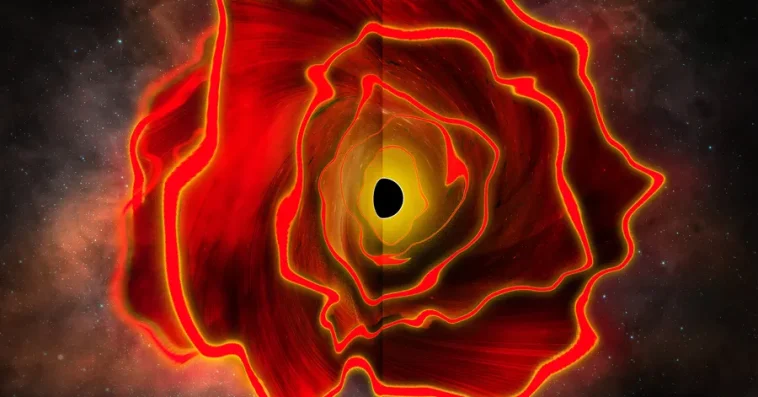
When Soundgarden penned “Black Hole Sun,” they likely didn’t envision a literal cosmic entity embodying such a paradox. Yet, recent groundbreaking observations from the James Webb Space Telescope (JWST) have brought forth a phenomenon that is every bit as mind-bending: “black hole stars.” These colossal structures, some the size of our entire solar system and glowing a fierce red, represent a startling new chapter in our understanding of the universe’s nascent stages.
Unveiling a New Class of Stellar Object
A seminal paper published in Nature details the compelling evidence for these extraordinary objects. Scientists, leveraging the unparalleled sensitivity of the JWST, focused on some of the most distant observable phenomena—signals emanating from a time when the universe was a mere 660 million years old. These appear as intensely bright, reddish spots in the telescope’s infrared images, initially defying easy classification.
The crucial insight is that these aren’t conventional stars. While they share characteristics with giant stars based on their emitted light, researchers hypothesize they are, in fact, black holes veiled in an extraordinarily dense and luminous shroud of gas. This innovative concept, dubbed “black hole stars,” challenges existing astrophysical models and opens new avenues for exploring cosmic evolution.
The Anomalous Signature of MoM-BH*-1
At the heart of this research lies an object designated MoM-BH*-1. From billions of light-years away, it presents as a gigantic, star-like entity. However, its properties are profoundly anomalous. It emits an astonishing 100 billion times more energy than any star could possibly generate through nuclear fusion alone. Even for the high-energy environment of the early universe, this object’s luminosity is exceptional.
Further complicating its classification is a peculiar characteristic: a significant portion of its light abruptly disappears. While stellar atmospheres can absorb certain wavelengths, the effect observed in MoM-BH*-1 is far too intense to be explained by normal stellar processes. This intense absorption strongly suggests the presence of an enormous volume of incredibly dense gas acting as a cosmic filter.
The Black Hole Star Hypothesis: A Powerful Explanation
These compelling clues culminated in the black hole star hypothesis. This model posits a central black hole actively accreting matter, a process that releases immense quantities of energy. Surrounding this ravenous core is a massive envelope of gas. As the intense energy from the black hole blasts through this dense gas, it heats it to extreme temperatures, causing it to glow brightly and acquire some of the spectral characteristics typically associated with starlight, effectively mimicking a colossal star.
This mechanism offers a powerful explanation for the observed super-luminosity and the distinct light absorption patterns. It implies a dynamic interplay between a burgeoning black hole and its immediate gaseous environment, creating a hybrid cosmic entity previously only theorized.
Resolving Early Universe Mysteries and Future Implications
The black hole star hypothesis could also illuminate another persistent enigma uncovered by the JWST: the surprising prevalence of small, unexplained red spots in the early universe. These ubiquitous signals have puzzled astronomers, as they don’t neatly fit into established categories of deep-space objects. Previous explanations have ranged from compact, star-forming galaxies to black holes obscured by dust, or even entirely novel cosmic systems.
The identification of black hole stars provides a compelling candidate for these mysterious “red dots.” If confirmed, these objects could represent a significant population of early universe structures, influencing everything from the reionization of the cosmos to the seeding of supermassive black holes that anchor modern galaxies. The ongoing revelations from the James Webb Space Telescope continue to push the boundaries of astronomical understanding, forcing us to re-evaluate the very processes that shaped the universe we inhabit today. Future observations and theoretical refinements will undoubtedly shed more light on these fascinating, paradoxical entities.
#TrendingNow #Innovation #TechNews #DailyVlog #LifeHacks #FitnessMotivation #TravelGoals #Foodie #Artistic #Motivation #DIY #Inspiration
Artificial Intelligence, Cloud, Cybersecurity