AMD’s Strategic Re-Entry: A Lifeline for Gamers in an AI-Dominated Market
The current landscape for hardware enthusiasts is undeniably challenging. As artificial intelligence applications increasingly monopolize high-performance silicon, the consumer market, particularly for components like GPUs and RAM, faces unprecedented pricing pressures and supply constraints. Amidst this turbulent environment, AMD is making a calculated move, offering a pragmatic solution to gamers by reintroducing proven, yet slightly older, hardware. This strategy, unveiled at Computex, aims to provide accessible performance when new, top-tier components are either prohibitively expensive or simply unavailable.
The Return of a Legend: Ryzen 7 5800X3D
A cornerstone of AMD’s renewed strategy is the global re-release of its highly acclaimed Ryzen 7 5800X3D processor. This chip, renowned for its innovative 3D V-Cache technology, fundamentally changed the gaming CPU landscape upon its initial launch. By integrating a significant L3 cache directly onto the CPU die, the 5800X3D dramatically reduced latency for gaming workloads, often outperforming even newer, higher-clocked processors in titles sensitive to cache performance. Its resurgence is a testament to its enduring relevance and AMD’s recognition of a persistent demand for high-value gaming CPUs. For many enthusiasts running AM4 platforms, this re-entry offers a compelling upgrade path without requiring a full system overhaul, a significant cost-saver in today’s market.
Radeon RX 9070 GRE: A Global Mid-Range Contender
Accompanying the CPU re-release is the global availability of the Radeon RX 9070 GRE. Initially launched exclusively in China as the “Golden Rabbit Edition” (GRE), this GPU is now stepping onto the world stage. Positioned with a suggested retail price of $549, it presents a more attainable option compared to the standard RX 9070, which launched at the same price point but now commands upwards of $600 in the retail market. This strategic pricing, if maintained by retailers, positions the RX 9070 GRE as one of the few semi-affordable choices for solid 1440p gaming, even incorporating a degree of ray tracing capability. Its global expansion signals AMD’s intent to capture a critical segment of the market that’s being squeezed by escalating prices at the high end.
Performance Insights: The “Golden Rabbit” Under the Hood
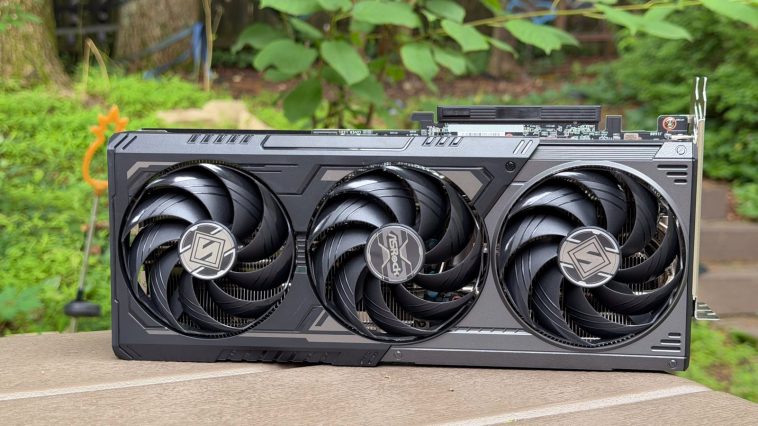
Our rigorous testing confirms that the Radeon RX 9070 GRE delivers performance remarkably close to its standard RX 9070 sibling. This is a crucial distinction, as GRE versions typically feature slightly lower specifications to hit more aggressive price points in specific markets. The ASRock RX 9070 GRE, a straightforward triple-fan cooled unit, houses 12GB of VRAM, which is less and slower than the 16GB found in the full 9070. It also incorporates eight fewer compute units and ray tracing accelerators. To partially offset these hardware reductions, AMD has boosted the 9070 GRE’s maximum clock speed to 2.79GHz, a notable increase over the 9070’s 2.52GHz.
In synthetic benchmarks, the GRE variant shows expected differentials. In 3DMark’s demanding Speedway test, it scored 4,334 points, trailing the standard RX 9070’s 5,799. However, the 9070 GRE proved more competitive in slightly older benchmarks, registering only about 700 points less than the 9070 in Steel Nomad and a mere 200 points less in Timespy Extreme. This suggests the card is particularly adept at handling current and slightly older titles, offering excellent value for a vast library of games.
Real-world gaming performance further reinforces its capabilities. In Forza Horizon 6, the RX 9070 GRE achieved an impressive average of 180 frames per second at 1440p with “RT High” settings and AMD’s FSR4 frame generation enabled. Without frame generation, it still managed a respectable 90 fps. Surprisingly, the card even proved capable of 4K gaming in Forza, averaging 80 fps with the same settings. While a “video memory low” warning was occasionally observed, it did not translate into any noticeable performance stuttering during testing, demonstrating the efficiency of AMD’s memory management and FSR technologies. Furthermore, the 9070 GRE showcased impressive thermal efficiency, reaching only 58°C under load and quickly cooling to 30°C after intensive sessions, all while maintaining remarkably quiet fan operation. This makes it an excellent candidate for builds prioritizing silence or compact form factors.
Market Dynamics and Future Implications
AMD’s strategy of re-releasing and globally expanding slightly older or region-specific hardware is a direct response to the unprecedented strain on the silicon supply chain, largely driven by the insatiable demand from the AI sector. This demand has fundamentally altered the economics of component manufacturing, diverting resources and driving up prices for cutting-edge technology. By leveraging established architectures and proven designs, AMD can offer products that deliver substantial performance without incurring the same manufacturing and R&D costs associated with brand-new releases.
This approach offers a crucial psychological win for consumers. In a market where waiting for the “next big thing” often means confronting even higher prices, AMD provides a tangible, immediate solution. It acknowledges that not every gamer requires the absolute bleeding edge, and that a significant portion of the market prioritizes value and accessibility for high-quality 1440p gaming. This could set a precedent for how hardware manufacturers navigate future supply disruptions and pricing volatility, potentially leading to more tiered offerings that cater to different budget and performance needs.
Conclusion: A Pragmatic Path Forward
Given the current market conditions, recommending any hardware upgrade comes with caveats. However, the Radeon RX 9070 GRE, paired with the re-emerging Ryzen 7 5800X3D, offers a compelling narrative for gamers in desperate need of an upgrade who cannot afford to wait indefinitely. It represents a solid, mid-range choice for immersive 1440p gaming, capable of delivering excellent visual fidelity and smooth frame rates, especially when leveraging AMD’s FSR technologies.
AMD’s pivot towards leveraging its strong existing portfolio demonstrates a pragmatic understanding of the current hardware landscape. It’s a strategic move that not only provides immediate value to consumers but also highlights a potential shift in how the industry approaches product cycles in an era increasingly defined by external market forces. For gamers seeking a powerful yet sensible upgrade today, AMD offers a clear, well-performing path forward.
#HashtagTips #SocialMedia #EngagementBoost #ContentMarketing #DigitalStrategy #TrendingNow #AudienceGrowth #ViralContent #InstaTips #MarketingHacks #ReachMore #GrowYourBrand
Artificial Intelligence, Generative AI, Cloud