The Age-Gating Frontier: AI’s Leap from Digital Screens to Physical Borders
The internet is increasingly becoming an age-gated domain. From stringent social media restrictions in Australia to adult content consumption laws in numerous US states, users are routinely asked to verify their age to access digital platforms. This pervasive trend, however, is now poised to transcend the virtual realm, with significant implications as AI-driven age verification technologies begin to infiltrate the offline world.
The Expanding Reach of Age Verification
What began as a measure to protect minors online has rapidly evolved into a complex ecosystem of digital identity checks. Laws are continually tightening, mandating robust age verification for an ever-growing list of online services. This landscape has spurred a rapid advancement in technologies designed to accurately assess a user’s age, often through sophisticated algorithms and biometric analysis.
The transition from online safeguards to real-world applications marks a critical pivot. As digital age verification becomes commonplace, the underlying technologies are being explored for broader, non-digital scenarios, pushing the boundaries of how we interact with technology and governance.
AI at the Border: A New Frontier for FAE
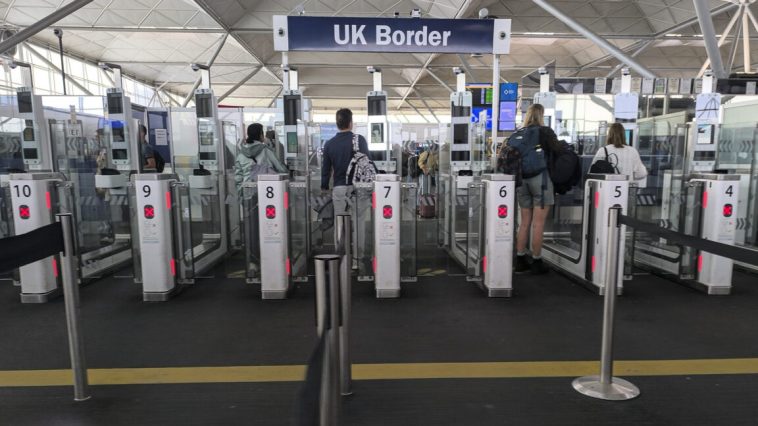
In a groundbreaking and potentially controversial move, the British government is slated to implement facial age estimation (FAE) technology starting next year. This marks a pivotal moment, as AI systems that scan and predict an individual’s age are set to be deployed at the UK border to assess asylum seekers. This initiative is believed to be the first of its kind globally, establishing a precedent for the use of such technology in highly sensitive contexts.
Many asylum seekers arriving in the UK lack official documentation to prove their age. The stakes are extraordinarily high: misclassifying a child as an adult can strip them of vital legal protections and condemn them to adult detention facilities, with severe psychological and physical consequences. This deployment underscores a significant shift in how states might leverage AI for demographic assessment and border control.
Unsettling Accuracy and Bias Concerns
However, the efficacy and fairness of these FAE systems are already under intense scrutiny. A collaborative investigation by WIRED and Lighthouse Reports, supported by The Independent, has unearthed a critical internal UK government report. This document details tests of FAE technologies, revealing disturbing findings: the systems frequently misidentify children as adults.
Crucially, the investigation highlighted significant bias issues within these FAE algorithms. These biases disproportionately affect the largest groups of migrants expected to undergo age assessments in 2025, according to Home Office data. Such algorithmic flaws raise profound questions about the reliability and ethical implications of deploying unproven AI in situations where human lives and rights hang in the balance. The potential for systematic discrimination and incorrect classifications demands immediate and thorough re-evaluation.
Future Implications and Ethical Crossroads
The UK’s decision to deploy FAE at its borders represents a critical juncture, not just for Britain, but for the global community. If successful, however flawed, it could pave the way for other nations to adopt similar AI-driven solutions for managing migrant populations, potentially eroding established human rights frameworks and due process. This application of FAE moves beyond simple online access and into core questions of legal identity and vulnerability.
The broader societal implications of FAE’s offline integration are vast. What begins with border control could extend to other public services, age-restricted purchases in physical stores, or even employment verification. The critical challenge lies in balancing the purported efficiencies of AI with fundamental ethical considerations such as privacy, the right to accurate identity, and protection from algorithmic discrimination. We are entering an era where AI’s predictive capabilities could profoundly reshape individual experiences, demanding rigorous oversight, transparent methodologies, and a commitment to human-centric design. The unfolding debate around FAE at the border will undoubtedly serve as a crucial barometer for the future of AI governance in high-stakes environments.
#TrendingNow #ViralContent #ExplorePage #ForYou #Innovation #TechTrends #DailyDose #Inspiration #Motivation #LifeHacks #MustWatch #DeepDive
Artificial Intelligence, Cloud, Cybersecurity