Safeguarding Our Digital Civilization: A Bold New Era of Planetary Defense Against Solar Storms
The relentless march of technological progress has interwoven our daily lives with an intricate web of satellites, communication networks, and electrical grids. This indispensable infrastructure, however, remains acutely vulnerable to the unpredictable fury of extreme space weather. While the awe-inspiring auroras paint our polar skies, the most potent solar eruptions harbor the power to cripple global systems, prompting researchers to propose an audacious space-based defense system designed to mitigate these celestial threats before they reach Earth.
The Silent Threat: Unpacking Geomagnetic Storms
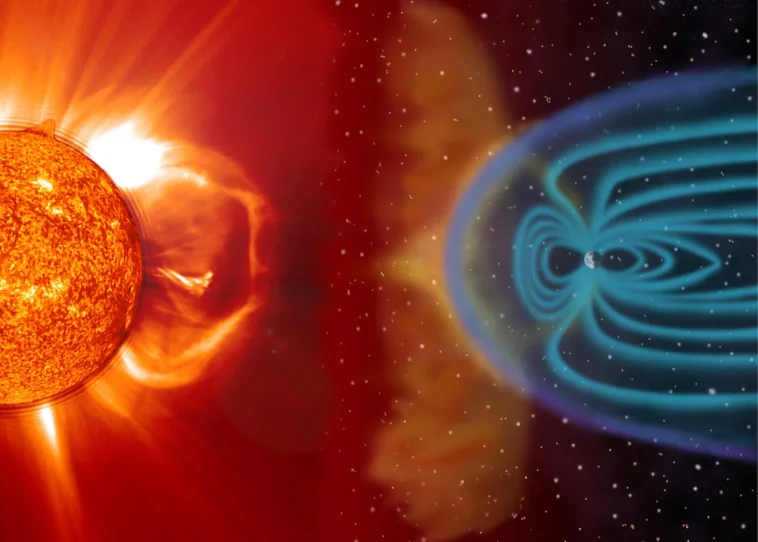
Our sun, a seemingly benevolent life-giver, periodically unleashes colossal pulses of radiation, energetic particles, and magnetic fields. These phenomena, known as solar storms, interact dynamically with Earth’s protective magnetosphere. While lesser events manifest as spectacular light shows, the most violent ejections can trigger severe geomagnetic storms, capable of disrupting critical GPS and radio communications, and inflicting catastrophic damage on electrical equipment. The increasing density of our orbital infrastructure, from navigation satellites to broadband constellations, amplifies the potential for widespread disruption, making this a growing concern for national security and economic stability.
Echoes of the Past: The Carrington Event and Modern Vulnerability
History offers a stark warning. The 1859 Carrington Event, the most powerful solar storm ever recorded, famously incapacitated telegraph systems across North America and Europe. In today’s hyper-electrified and interconnected world, a comparable event would unleash unprecedented chaos. Economic models project potential damages ranging from $2.4 trillion to $3.4 trillion to the global power grid alone. Beyond infrastructure, such a cataclysm could trigger cascading failures across financial markets, supply chains, emergency services, and transportation networks, effectively plunging vast regions into a pre-digital dark age. The potential for long-term societal disruption underscores the urgent need for proactive defense strategies.
Introducing Project StormWall: An Orbital Airbag for Earth
In a groundbreaking development, researchers from Boston University and the University of Michigan have unveiled a revolutionary concept: Project StormWall. Detailed in a paper published in Space Weather, their proposal outlines a constellation of satellites engineered to deploy hundreds of tons of gas into orbit, effectively blunting the force of incoming solar storms. This visionary approach aims to create, as co-author Daniel Welling aptly describes, “an airbag in the magnetosphere”.
How StormWall Fortifies Earth’s Shield
The destructive potential of solar storms stems from their ability to weaken Earth’s natural magnetic shield, allowing energy from the sun to pour into our planet’s magnetosphere when magnetic field lines “reconnect.” Fortunately, Earth possesses a natural defense: a doughnut-shaped reservoir of ionized gas, or plasma, situated just above the atmosphere. When our planet’s magnetic field is disturbed, a plume of this plasma naturally flows outward, helping to slow the rate of magnetic reconnection.
StormWall proposes to dramatically enhance this natural process. The system would comprise a constellation of satellites orbiting approximately 22,000 miles from Earth. Equipped with canisters of lithium, barium, or sodium gases, these satellites would strategically eject their payload upon the detection of a significant inbound solar storm. Rapidly ionized by solar radiation, these artificial plasma clouds would augment Earth’s existing plasma shield, effectively reinforcing our planetary defenses. The precise choice of gases is critical, leveraging their ionization properties to maximize their impact on magnetospheric dynamics.
Feasibility and Logistics: A Grand Orbital Undertaking
Simulations conducted by the research team indicate that releasing approximately 400 tons of gas could reduce the strength of a major geomagnetic storm by over 50 percent. Crucially, this intervention would be both swift and reversible, with the protective plasma cloud dissipating within hours after deployment. While launching such a substantial amount of material into orbit presents a monumental engineering challenge, the researchers believe it is well within the capabilities of emerging heavy-lift vehicles such as SpaceX’s Starship or China’s Long March 9 rocket. Their calculations suggest that a full StormWall constellation could be deployed with as few as six launches in under two months. This demonstrates a tangible pathway from theoretical concept to practical implementation.
The Path Forward: Challenges and Broader Implications
The scientific community has largely reacted positively to the StormWall concept. Allison Jaynes, a space physicist at the University of Iowa, commended the idea as “highly innovative and appears to be quite feasible in the near term”. However, the journey from proposal to deployment is fraught with challenges. Beyond the logistical complexities of orbital deployment, accurate and timely space weather forecasting remains a critical prerequisite. Precise prediction of a storm’s trajectory and intensity is paramount to optimize the timing and scale of StormWall’s intervention.
Furthermore, gaining international consensus and buy-in for a system that would intentionally, albeit temporarily, alter the near-Earth space environment presents a significant diplomatic hurdle. Ethical considerations surrounding planetary-scale geoengineering initiatives, even for protective purposes, must be thoroughly addressed. Researchers are also meticulously studying potential side effects, such as the generation of electromagnetic waves as the released material ionizes. Despite these complexities, the catastrophic potential of a Carrington-sized event in our modern world strongly suggests that the potential benefits of Project StormWall may decisively outweigh its inherent risks. This initiative heralds a new era of proactive planetary defense, transforming our relationship with the dynamic and often tumultuous environment of space.
#TrendingNow #ExplorePage #ViralContent #Innovation #Motivation #DigitalMarketing #TechGadgets #HealthAndWellness #TravelAdventures #FoodieLife #FashionStyle #DailyInspiration
Artificial Intelligence, Generative AI, Large Language Models