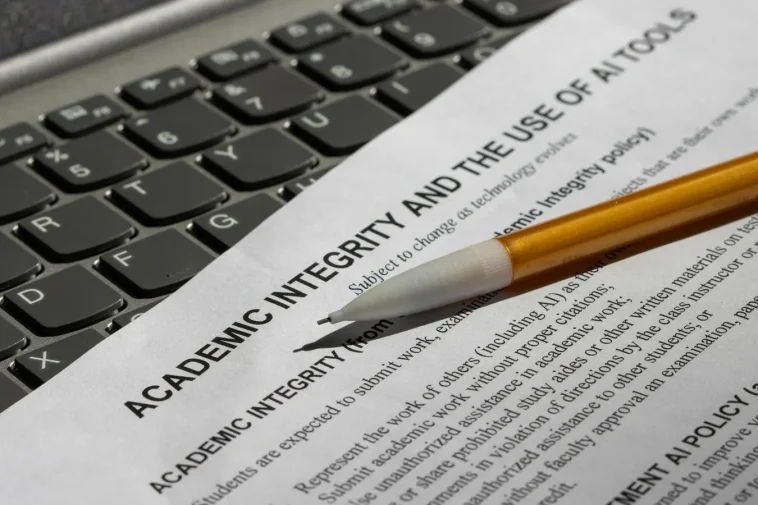
Navigating the AI Frontier: Higher Education Grapples with Shifting Paradigms of Learning and Integrity
The rapid proliferation of generative artificial intelligence (AI) has plunged higher education into a period of profound reevaluation, challenging long-held assumptions about academic integrity and the very definition of learning. While some observers fear a widespread epidemic of AI-driven cheating, others suggest the impact is more nuanced. The reality, as a new study in the journal Science reveals, points to a crucial need for universities to provide clearer guidance and adapt their pedagogical strategies to this evolving technological landscape.
Unpacking AI Use Across Disciplines
A groundbreaking study, co-authored by Rene Kizilcec, an associate professor of information science at Cornell University and director of the Cornell Future of Learning Lab, sheds light on student engagement with AI. Challenging popular anxieties that have largely focused on AI’s role in writing essays, the research indicates that generative AI use is most prevalent in quantitative fields such as computer science, business, and economics. This finding, derived from a survey of 95,500 students across public U.S. research universities, suggests that students are leveraging AI for tasks like code generation, data analysis, and problem-solving, rather than solely for generating prose.
While two-thirds of students reported using generative AI during the 2023-24 academic year, a smaller but still significant portion admitted to questionable practices. Only 9% of all surveyed students acknowledged knowingly submitting AI-generated work when it might not have been permitted. However, among daily AI users, this figure dramatically escalates to 26%, underscoring a critical correlation between frequent AI engagement and the propensity for academic misconduct. This trend suggests that as AI tools become more integrated into students’ routines, the challenge of upholding academic integrity will likely intensify.
The Credibility Crisis: Degrees Under Scrutiny
Kizilcec cautions that the implications of AI extend far beyond mere cheating. He argues that AI is exposing fundamental weaknesses in how colleges currently measure learning and, consequently, whether academic degrees reliably signal competence to future employers. The integrity of institutional credentials and the broader trust in academic rigor are at stake. This challenge demands a comprehensive re-evaluation of assessment methodologies that effectively distinguish human ingenuity and understanding from AI-generated outputs.
This concern is already catalyzing significant shifts in educational policy. Notably, Princeton University’s faculty recently voted to reintroduce proctors for in-person exams starting July 1, 2026, ending a 133-year tradition of unsupervised testing rooted in its honor code. This historic decision highlights the profound pressure institutions face in safeguarding academic honesty in the age of AI.
Rethinking Assessment in an AI-Augmented World
Kizilcec acknowledges the appeal of honor systems but emphasizes that AI has amplified existing competitive pressures within higher education, where high-stakes grading can inadvertently incentivize misuse. Data from other prestigious institutions reinforce this reality; a Harvard Crimson survey of approximately 300 students revealed that over 40% admitted to regularly using AI for coursework in ways instructors might deem inappropriate.
In response, many colleges are exploring or re-adopting more controlled assessment environments, including handwritten essays, proctored in-class examinations, and oral exams that compel students to articulate their understanding in real-time. However, Kizilcec warns against viewing traditional “blue book” exams as a panacea. Such methods often fail to evaluate broader professional skills crucial for the modern workforce, such as judgment, collaboration, and the ability to effectively utilize AI tools responsibly.
Progressive approaches are emerging, particularly in fields like computer science. At Columbia University, some professors are moving beyond simply evaluating polished final outputs. Instead, they are emphasizing students’ capacity to explain, critique, and iteratively improve AI-assisted work, focusing on the critical human oversight required for effective AI integration. This approach prepares students for a future where proficiency often means collaborating intelligently with AI, not merely bypassing it. The overarching sentiment among educators is clear: the methods for assessing student learning must fundamentally evolve.
Forging a Path Forward: Clear Guidelines and Faculty Empowerment
For prospective students and their families, the conversation around AI in higher education should transcend simple bans on tools like ChatGPT. The focus should instead be on a university’s comprehensive and coherent strategies for adapting assessment to the AI era.
A significant hurdle, Kizilcec notes, is the pervasive ambiguity surrounding acceptable AI use among students. Many course syllabi offer vague directives, ranging from outright prohibition to unrestricted use, leaving students without crucial nuanced guidance. The Science report strongly advocates for clearer, course-specific guidelines that delineate appropriate AI applications—whether for brainstorming, editing, coding, or providing feedback—and where it crosses the line into undermining core disciplinary thinking.
Crucially, this adaptation requires substantial investment in faculty training. Many educators are still navigating the capabilities and limitations of AI themselves, even as students rapidly integrate the technology into their learning processes. Universities must expand workshops and resources to equip professors with the knowledge and pedagogical strategies needed to effectively incorporate AI into their teaching and assessment. As Kizilcec aptly states, while AI offers numerous ways to support the learning process, other applications can dangerously undermine it by fostering a reliance that diminishes true agency and critical thought.
Ultimately, the challenge for higher education is not to suppress AI, but to harness its potential by redesigning assessments that accurately measure genuine student comprehension, critical thinking, and the ethical application of these powerful new tools. This pivotal moment presents an unprecedented opportunity for pedagogical innovation, ensuring that degrees continue to represent a true testament to human intellect and capability in an increasingly AI-driven world.
#TrendingNow #ViralContent #ExplorePage #ForYou #Innovation #Tech #AI #FutureIsNow #DigitalMarketing #SocialMedia #CreatorEconomy #Motivation
Artificial Intelligence, Cloud, Cybersecurity