InnovationWarrior.com
## The Celestial Ballet Unfolds: A Rare Daytime Spectacle
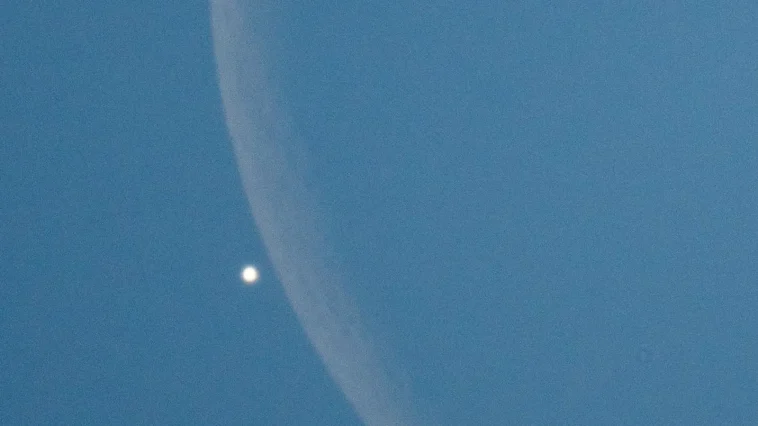
Skywatchers across the U.S. and significant portions of Canada are poised to witness a truly exceptional astronomical event this Wednesday, June 17, 2026. For the first time in 11 years, the dazzling planet Venus will momentarily vanish behind the slender crescent moon in a spectacular phenomenon known as a lunar occultation – all occurring in broad daylight. This rare alignment offers a unique opportunity to connect with the cosmos, demanding careful observation and adherence to safety guidelines.
This dramatic celestial performance will see Venus disappear behind the moon’s unilluminated limb before gracefully re-emerging about an hour later. The visibility extends beyond North America, encompassing parts of Brazil and Venezuela, making it a truly hemispheric event. Such daytime occultations are particularly challenging and rewarding, transforming the mundane blue sky into a stage for cosmic drama.
## Navigating the Daylight Sky: Essential Safety Protocols
Observing a daytime celestial event, especially one involving the moon and a bright planet, requires paramount attention to eye safety. Unlike nighttime viewing, the sun’s presence in the sky poses a significant risk. Experts strongly advise against pointing binoculars or telescopes directly at the sun, as this can cause immediate and permanent vision damage.
Dr. Tony Phillips of Spaceweather.com suggests a simple yet effective method: “Go outside under the blue sky and stand in the shadow of a building. Scan the blue sky with binoculars until you find the moon’s pale crescent.” This technique naturally shields observers from the direct glare of the sun while allowing the subtle crescent moon, a mere 11% illuminated and approximately 38 degrees from the sun, to become visible. Once located with binoculars, both the moon and Venus may even be discernible to the naked eye. Bob King from Sky & Telescope elaborates, advising to “Find the moon and look just to its left for a spark of white light glimmering against the blue sky.” This guidance is crucial for a safe and memorable viewing experience.
## Precision Timing: Your Guide to the Event
While the occultation is visible across the continental U.S. and much of Canada, the exact timings for both Venus’s disappearance and reappearance are highly dependent on your specific geographical location. This variability is due to the moon’s continuous motion across the sky and the curvature of the Earth. Astute observers will want to consult precise local timings to ensure they don’t miss a moment of this fleeting event.
The International Occultation Timing Association (IOTA) provides exhaustive timings, though these are typically listed in Universal Time (UTC), necessitating the use of a timezone converter for local accuracy. For those on the East Coast of the U.S., the occultation is expected to commence around 4:00 p.m. EDT, while West Coast observers can anticipate the start closer to 11:40 a.m. PDT. This broad time window ensures that many will have the opportunity to witness at least a portion of this unique celestial alignment.
Here are some illustrative timings for various U.S. cities, showcasing the variation in duration:
* Newark, New Jersey: 3:53:21 p.m.–5:10:27 p.m. EDT (1 hour, 17 minutes, 6 seconds)
* Philadelphia, Pennsylvania: 3:51:21 p.m.–5:11:19 p.m. EDT (1 hour, 19 minutes, 58 seconds)
* Chicago, Illinois: 2:24:49 p.m.–3:50:09 p.m. CDT (1 hour, 25 minutes, 20 seconds)
* Houston, Texas: 2:29:27 p.m.–3:36:04 p.m. CDT (1 hour, 6 minutes, 37 seconds)
* Dallas, Texas: 2:18:13 p.m.–3:34:35 p.m. CDT (1 hour, 16 minutes, 22 seconds)
* Fort Worth, Texas: 2:17:54 p.m.–3:33:58 p.m. CDT (1 hour, 16 minutes, 4 seconds)
* San Antonio, Texas: 2:26:06 p.m.–3:23:53 p.m. CDT (57 minutes, 47 seconds)
* Phoenix, Arizona: 11:50:54 a.m.–12:55:07 p.m. MST (1 hour, 4 minutes, 13 seconds)
* San Diego, California: 11:44:10 a.m.–12:43:14 p.m. PDT (59 minutes, 4 seconds)
* Los Angeles, California: 11:40:38 a.m.–12:44:07 p.m. PDT (1 hour, 3 minutes, 29 seconds)
## Beyond the Occultation: An Evening Astronomical Encore
Even if direct observation of the daytime occultation proves challenging, the evening sky on June 17 promises its own compelling spectacle. Approximately an hour after sunset, turn your gaze westward to witness a breathtaking alignment of celestial bodies. The 12%-lit waxing crescent moon, having moved slightly from its daytime encounter with Venus, will be beautifully framed alongside three luminous planets: Venus itself, Jupiter, and Mercury. This “planet parade” offers a superb wide-field view for casual observers and astrophotographers alike.
Adding another layer of wonder, training your binoculars on the crescent moon will reveal a myriad of distant stars. This stellar tapestry is none other than the Beehive Cluster, also known as M44 or Praesepe, nestled within the constellation Cancer. This open cluster, comprising roughly 1,000 stars, presents a glittering backdrop to the moon’s delicate crescent, showcasing the vastness and intricate beauty of our galactic neighborhood. For those unable to observe directly, the Virtual Telescope Project will offer a livestream of this remarkable alignment, beginning at 19:45 UTC (3:45 p.m. EDT), bringing the wonders of the Italian robotic telescopes to a global audience. This continuous engagement with celestial phenomena reinforces our connection to the universe and fuels the spirit of scientific inquiry.
Wishing you clear skies and wide eyes for this extraordinary event.
#Hashtags #Engagement #SocialMedia #Trending #Viral #ContentMarketing #DigitalMarketing #ExplorePage #ForYou #Community #Innovation #Creative
Artificial Intelligence, Cloud, Cybersecurity