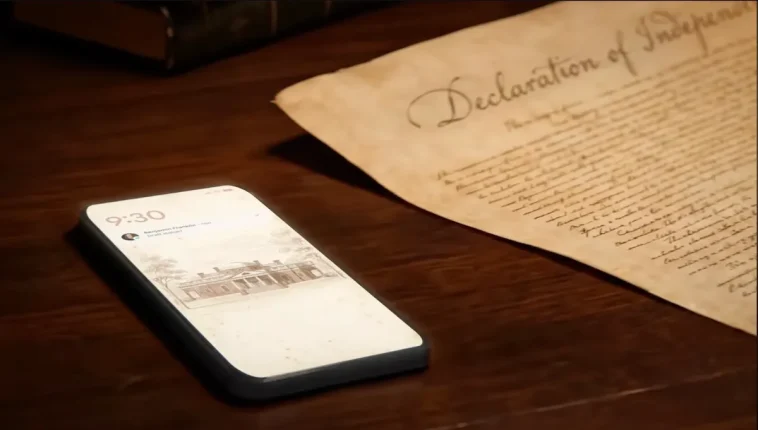
Google Envisions a Digital Declaration: A Bicentennial Reflection on Collaboration and AI
As the United States approaches its 250th anniversary, Google has launched a thought-provoking commercial that catapults the Founding Fathers into the digital age. The ad boldly asks: What if the architects of American independence had access to Google Workspace? This imaginative premise, encapsulated by the tagline “Group project, but make it 1776,” serves as a potent commentary on the evolution of collaboration and the pervasive influence of modern technology.
A Digital Declaration: Google’s Vision of 1776
The commercial playfully depicts Thomas Jefferson mid-draft, interrupted by a text from Ben Franklin, initiating a quintessentially modern collaborative process. Key Google Workspace features are seamlessly integrated into the historical narrative. Edits flow through Google Docs, meetings are scheduled via Google Calendar, and critical discussions unfold remotely on Google Meet, albeit with a humorous nod to the ubiquitous “cameras off” phenomenon. The entire monumental undertaking culminates in the swift finalization of documents with e-signatures, a stark contrast to the laborious parchment and quill of the 18th century. The advertisement effectively highlights how these digital tools are engineered to streamline complex workflows and enhance productivity, regardless of the historical context or the gravity of the task at hand. It underscores the universal desire for efficient communication and seamless document management, a challenge that transcends centuries.
AI’s Subtle Hand in Shaping History
In a reflection of 2026’s technological landscape, artificial intelligence also makes a discreet appearance. The fictionalized founders leverage Google’s “help me visualize” AI tool to explore various animal options for the national seal, showcasing generative AI’s creative potential. Gemini, Google’s advanced AI, is depicted taking meeting notes and even advising the revolutionaries on how to handle King George III’s document access request. Notably, the ad maintains a relatively understated approach to AI evangelism, particularly when contrasted with other recent tech advertisements. It thoughtfully refrains from suggesting that AI could “improve” the actual text of the Declaration of Independence, a nuanced decision that acknowledges the sanctity of foundational human creativity. However, the commercial subtly hints at the future of digital content creation, with some viewers noting an “uncanny glow” that suggests the footage itself might be AI-generated, further blurring the lines between reality and synthetic media.
The Divisive Discourse: Public Reaction to Tech’s Historical Rewrite
The commercial’s blend of history, humor, and technology has elicited a bifurcated public response. While platforms like YouTube and Instagram report largely positive viewer comments, the reaction on Bluesky has been notably more critical. Users there have labeled the ad as “cringey” and “stunningly tone deaf,” with the AI integration drawing the most significant ire. Critics, including historian Angus Johnston, have pointed out the minimal actual AI involvement in the narrative, stating, “Even in a corny fantasy joke, it’s impossible to make the case that AI is a useful tool for political organizing, writing, or human collaboration.” This divergence in reception underscores the ongoing cultural tension between the enthusiastic embrace of technological advancement and a more conservative, critical view when such innovations intersect with revered historical narratives. It highlights the challenges tech companies face in marketing AI, especially when attempting to inject humor or modern convenience into historically significant moments.
The Future of Collaboration: Beyond the Bicentennial
Google’s commercial, while a fictionalized romp, sparks a broader conversation about the future of collaboration and the evolving role of AI. The tools demonstrated—from intelligent document editing to AI-powered note-taking and visualization—are rapidly becoming indispensable in modern workplaces, from agile startups to established global enterprises. The ad provocatively asks us to consider not just how historical figures might have worked, but how contemporary “founding fathers” in various fields are working today, enabled by sophisticated digital ecosystems. Yet, it also reignites crucial questions about the true nature of human collaboration, creativity, and decision-making in an increasingly AI-augmented world. As AI becomes more deeply embedded in our productivity suites, the debate over its utility—whether it genuinely enhances human collective effort or merely automates tasks—will only intensify, urging us to critically assess the implications of our reliance on these powerful new tools.
The Google commercial ultimately serves as both a celebration of technological progress and a mirror reflecting society’s complex relationship with it. As we look towards the next quarter-millennium, the blend of historical reverence, technological aspiration, and critical public discourse will undoubtedly continue to shape how we envision the very act of creation and collaboration.
#EngagementBoost #SocialMediaTips #TrendingNow #ContentMarketing #DigitalStrategy #AudienceEngagement #MarketingTips #ViralContent #CommunityBuilding #BrandAwareness #ReachForTheStars #GrowYourBrand
Artificial Intelligence, Cloud, Cybersecurity