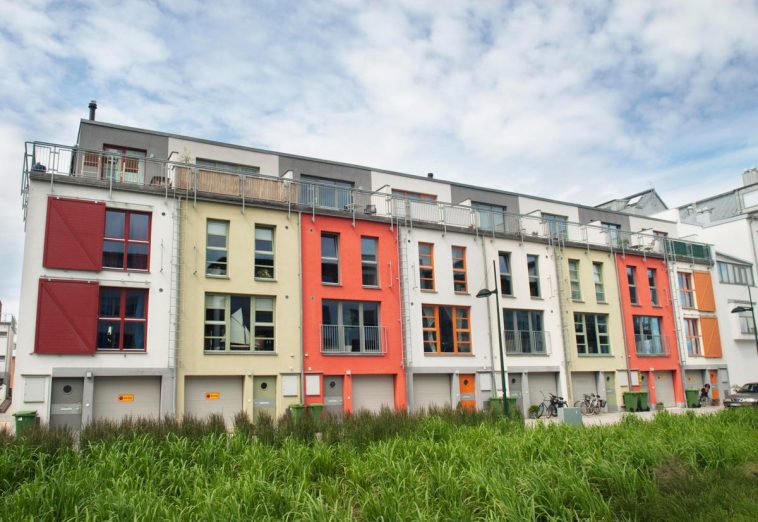
Bo01 Housing Expo – The City of Tomorrow in the ecologically sustainable information and welfare … [+]
Getty Images
Developing sustainable urban policies is seeing a momentum especially in the past years, as cities now have to quickly roll out local strategies to continue their journey into becoming more equitable and resilient in light to the climate crisis and post pandemic.
Between 11 and 13 May, the international three-day ICLEI World Congress held in the Swedish city of Malmö by the Local Governments for Sustainability network ICLEI brought together over 100 cities, regional governments and urban practitioners, to showcase best practices in local sustainable development in order to thrive towards a climate neutral future: “The fact that the entire world is spending billions of dollars to mitigate and recover from the COVID19 crisis, shows that local and regional governments indeed need to adopt a broader understanding of resilience in their jurisdictions and, consequently, take integrate preventive risks measures in the urban planning and municipal operations of cities,” said Gino Van Begin, ICLEI Secretary General.
Leveraging their roles at national and international level, mayors and regional authorities have been using the power of urban diplomacy, to be able to enter the centre of the political debate, and to promote transformative change at the urban level.
Public procurement has a key role in the advancement of a sustainable urban development and new technologies and shared knowledge are fostering the transition to innovative processes, but accelerating such process will require to allocate dedicated fundings, private participation and cooperations.
Solidarity & Urban Diplomacy
Understanding urban demographics and citizens’ needs and being able to respond to their demands is at the basis for building a truly sustainable community. The conference highlighted that there is still work to do on the gender based policies, but also more inclusive measures to turn cities into more resilient actors.
The core theme of the conference has indeed been solidarity, which has however taken a new turn as the Ukraine crisis unfolded in the last few months, presenting urban leaders with the renewed and cyclical challenge to respond to migration flows and collateral effects such as the the rocketing energy and food prices affecting citizens.
Urban diplomacy is bringing mayors closer to the political debate and enabling them to participate in the international system. Local and regional authorities at the summit emphasized that they will continue to undertake the necessary sustainability efforts and implement comprehensive solutions that are geared to enhance the sustainability of humankind: “Many ICLEI members, in particular in Europe, started immediate solidarity roll-out programs to welcome and assist Ukrainian cities and their forced refugees who had to flee their country,” said Van Begin.
An example here is the German city of Freiburg, which through its sister partnership relations with Lviv, Ukraine mobilized more than $ 5,2 million of cash assistance during the first week of the Russian invasion of the Ukraine. Many similar peer-to-peer cooperation examples can be found: “Malmö has a long history of receiving refugees from many different parts of the world. We are ready to do our part and help out in the current Ukrainian migration situation,” said Katrin Stjernfeldt Jammeh, Mayor of the Swedish city of Malmö and ICLEI first vice president.
EU Digitalisation & Fundings
Sustainable public procurement can be used to contribute to just an equitable societies, as public buyers spend 40 percent of the US GDP, but communities cannot only rely on this financial instrument.
Building political capacity internationally is leading cities to a better possibility to find financial opportunities to implement climate neutral policies. Dedicated grant funding to support cities, have now been developed by financial institutions such as the World Bank’s City Climate Finance Gap Fund, which however requires strong KPI and verification framework in order to be obtained.
Decarbonisation is now one of the main priorities of the European Union. EU funded project, under the European Horizon 2020 programmes have been able to help cities such as Amsterdam, Copenhagen,Paris, Helsinki, Stavanger and Berlin to go through pre commercial procurement process to find solutions that can reduce their GHG emissions within their energy and mobility domains.
The European Union has now launched EU 100 Climate Neutral Cities project, a new programme including 100 cities across the 27 members states, which will receive $ 375 million funding between 2022-23, to start the innovation paths towards climate neutrality by 2030. Climate City Contracts that includes an overall plan for climate neutrality will be agreed with each selected urban entity: “Philanthropic capital providers and financial institutions are looking for a verification of achieved environmental impact. The contract we stipulate needs to be rock solid, certifiable, and validatable,” said Matthew Baldwin, European Commission Manager of EU 100 Climate Neutral Cities project, arguing that concrete plans can be the only way to avoid greenwashing and poor implementation.
Private sector engagement is however key to further promote transition to resilient urban areas. During the conference, Google’s philanthropy committed to support the ICLEI Action Fund with $ 7 million dollar fund. The granting scheme will help design, and operate more sustainable or regenerative urban areas in the European cities of Barcelona, Berlin, Glasgow, Helsinki, Malmö, Rome, Rotterdam, and Stockholm. The fund will be given to projects that tackle cities’ just transition with an emphasis on decreasing urban emissions from mobility and buildings through technologies such as solar energy and air quality management systems: “Google is committed to helping more than 500 cities reduce one gigatonne of carbon emissions annually by 2030 through providing local governments with better access to data and technology. We also want to empower deeper collaboration with civil society,” said Rowan Barnett, director of Google.org, Europe, Middle East & Africa.
The ICLEI World Congress primarily committed to promote technological approaches able to spark behavioral change within urban communities, emphasising however such technological infrastructures have to live up to liability principles, and privacy rights.