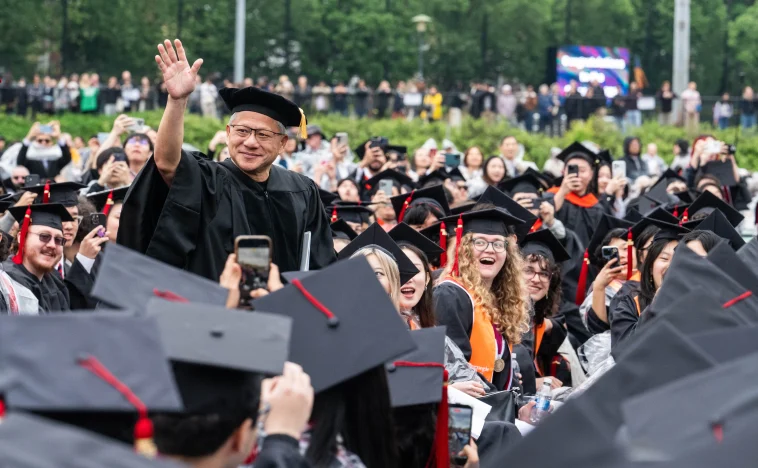
Graduation 2026: Tech Titans Deliver a Mixed Message on the AI Revolution
The Class of 2026 stands at a unique crossroads in history, marking the first cohort to navigate their entire collegiate journey under the omnipresent shadow and burgeoning influence of generative artificial intelligence. As these graduates donned their caps and gowns, a roster of the tech world’s most formidable leaders — including Nvidia CEO Jensen Huang, AMD CEO Lisa Su, and former Google CEO Eric Schmidt — stepped onto commencement stages to impart wisdom. Their overarching message was consistent: embrace AI, but crucially, learn to master its complexities. Yet, the reception of this seemingly unified counsel varied dramatically, painting a vivid picture of the anxieties and aspirations defining the dawn of the AI age.
The Polarized Podium: Contrasting Receptions
The stark divergence in audience response was palpable across the nation’s campuses. At the University of Arizona, Eric Schmidt’s buoyant optimism regarding AI was met with pronounced jeers and boos, indicating a deep-seated apprehension among graduates. In stark contrast, Jensen Huang, delivering his address at Carnegie Mellon University, received his similarly forward-looking message with quiet reverence, a testament to the differing perceptions of AI’s impact and its proponents.
Further illustrating this divide, Scott Borchetta, founder of Big Machine Label Group, faced palpable pushback at Middle Tennessee State University when discussing AI’s disruption of the creative industries, advising graduates to simply “deal with it.” Meanwhile, Apple co-founder Steve Wozniak, at Grand Valley State University in Michigan, garnered sustained applause with a clever twist on the narrative, reminding students, “You all have A.I.—actual intelligence.” These reactions underscore a generational chasm in how AI’s disruptive potential is perceived and processed.
Unpacking the Divide: Reputation, Institution, and Trust
The varied responses were not merely a reflection of individual speeches but deeply rooted in the speakers’ reputations, the institutional context, and the perceived authenticity of their message. Students at elite institutions, particularly those with a strong history in technological advancement like Carnegie Mellon – widely acknowledged as one of AI’s birthplaces – and MIT, where Lisa Su also received a warm reception, appeared more receptive to pro-AI narratives. These institutions often possess advanced research facilities and closer ties to cutting-edge development, perhaps fostering a more informed and less fearful perspective on technological evolution.
Conversely, the skepticism observed at public universities and among creative arts students highlights a different reality. For many, the abstract promises of AI are overshadowed by immediate concerns about job displacement, the erosion of traditional career paths, and the widening skills gap. The speakers themselves also played a critical role. Jensen Huang and Lisa Su, as active architects of the AI infrastructure, are seen as embodying tangible innovation and risk-taking. Eric Schmidt, in contrast, is often viewed as a relic of an older Big Tech era, and his delivery in Arizona amplified perceptions of being out-of-touch, making his optimistic pronouncements ring hollow for a segment of the graduating class.
Navigating a Shifting Professional Landscape
The Class of 2026 faces unprecedented challenges as they step into the workforce. The rapid advancement of AI tools has not only influenced academic choices but has profoundly reshaped career expectations. While national unemployment rates remain relatively low, the entry-level hiring market has experienced a severe contraction. This phenomenon is partly attributed to the lingering effects of remote work, with employers hesitant to onboard and train fresh graduates in virtual environments.
A recent Federal Reserve survey underscores this concerning trend, revealing that the unemployment rate for college graduates aged 22 to 27 has climbed to 5.7 percent, its highest point since 2014, excluding the anomalous pandemic years. This economic backdrop amplifies the anxieties surrounding AI, as graduates grapple with a job market that is not only competitive but fundamentally transforming. The imperative for continuous skill development and adaptability has never been more critical.
Mastering the AI Revolution: A Unified Call to Action
Despite the varied reception, the core advice from these tech leaders converged on a singular, powerful theme: disruption is inevitable, and adaptation is paramount. Jensen Huang eloquently framed the moment: “My career started at the beginning of the PC revolution. Your career starts at the beginning of the A.I. revolution. I cannot imagine a more exciting time to begin your life’s work. A.I. is not likely to replace you, but someone using A.I. better than you might.” This insight emphasizes not replacement by technology, but by individuals who leverage it more effectively.
Lisa Su echoed this sentiment, stating, “Technology itself does not decide what the future looks like. The best people do.” She further stressed the need for individuals with “purpose, judgment, and courage,” who are willing to tackle complex problems. Even Eric Schmidt, stripped of the snark his delivery received, delivered a similar message, highlighting AI’s pervasive reach across every profession and emphasizing that its utility hinges on human effort to understand and apply it. “The key thing is we need, as humans, to retain the sort of sense that hard work, going through the difficulty of learning things, is worthwhile and it pays off, and that’s how you really improve yourself,” he advised.
The future implications of this technological inflection point are profound. Graduates are not merely entering a job market; they are entering an era where human ingenuity must synergize with artificial intelligence. This demands a workforce that is not only proficient in technical skills but also possesses strong critical thinking, ethical reasoning, and interdisciplinary collaboration capabilities. The ability to integrate AI tools creatively and responsibly will differentiate success from stagnation. Continuous learning, therefore, is not just a recommendation but a foundational requirement for navigating a career landscape constantly reshaped by intelligent machines.
Shaping Tomorrow: The Imperative for Active Engagement
The Class of 2026 has been handed a powerful, albeit sometimes intimidating, tool. The challenge lies in moving beyond passive adoption to active shaping of AI’s trajectory. These graduates are not just inheriting the AI revolution; they are poised to become its architects, ethicists, and innovators. Their journey will define not only their individual careers but also the very fabric of society as it intertwines with increasingly intelligent systems. The message is clear: the future belongs to those who not only embrace AI but truly master its potential, guiding its evolution with purpose and judgment.
#TechTrends #FutureIsNow #InnovationHub #DigitalLife #AIRevolution #GadgetGoals #SmartLiving #DeepTech #FutureForward #NextGen #TechGeek #ExploreTech
Artificial Intelligence, Cloud, Data Science