

From embracing the circular economy model to making new plastics from old, PETRONAS is committed to taking climate action, tackling carbon emissions and transforming plastic waste.
Businesses have a critical role to play in mitigating global warming, and global energy group PETRONAS is demonstrating how seriously it takes sustainability by embarking on a purposeful journey toward climate action.
This journey is supported by the circular economy concept, and a systemic approach that cuts across the group’s various businesses. In addition, in November 2020, PETRONAS announced its aspiration to achieve net zero carbon emissions by 2050, in alignment with the Paris Agreement on Climate Change and the 2030 Agenda for Sustainable Development.
As a starting point, PETRONAS acknowledges that its operations rely heavily on finite natural resources and is aware of the consequent environmental footprint, from the hydrocarbon produced to the steel used in its facilities. “Therefore, it’s our duty to ensure that we consume responsibly and eliminate waste sustainably whilst ensuring long-term operations are run efficiently and safely,” says Ezrin Johanna Elias, Head of Circular Economy, Corporate Strategic Planning at PETRONAS. “Circular economy perfectly unlocks this for us,” she adds.
Ezrin Johanna Elias, Head of Circular Economy, Corporate Strategic Planning at PETRONAS
PETRONAS
The principles of circular economy—eliminate, circulate and regenerate—have been adopted by many parts of the group, from upstream to downstream, across the non-energy business segments in property, education and shipping, at varying levels of maturity and scale. “So, we have a foundation, and we are already seeing great results, especially on increased efficiencies,” says Ezrin.
Responsible businesses maintain profitability without overlooking the needs of society and the conservation of the environment, and PETRONAS is no different. One of the company’s key strategies is to keep adding value to its existing businesses. This is achieved by having an inclusive collaborative platform, not just within the group, but also with other industries as well. “Circularity works best when the ecosystem partners work together,” says Ezrin. “This complements the national agenda well, as there is a strong drive to push for circular economy in Malaysia, too.”
Rethinking Progress with New Models
Conventionally, industrial development has relied on exploiting natural resources based on the “take-make-dispose” approach— a linear economic model. Such a model is increasingly being shunned as businesses rise to meet the global demands for greater accountability of their actions. Brands that instead embrace the circular economy model within their modus operandi seek to decouple economic activity from the consumption of finite resources.
PETRONAS, being at the heart of many economies as a provider of energy, feedstock and energy-related solutions, has pivoted into circularity as a grounded way of aligning with international Environmental, Social and Governance standards. The company believes this will have positive multiplier effects on its partners and value chains.
Making this tectonic shift towards circularity, however, requires considerable investment, from reframing business models to technological advancement. For PETRONAS, such investments toward sustainable outcomes mean shoring up circular carbon, waste-to-product projects and bio solutions, essentially creating sustainable value. These are helping to put the group on course to realize their “net zero aspiration and sustainability agenda.”
One innovation that is underway involves plastic waste being processed into high-quality plastics that are recyclable indefinitely, bringing the prospect of cleaner land, beaches and seas a step closer.
New Plastics from Old, Then Repeat
Deeply concerned by plastic pollution, the Malaysia government called for a move away from single-use plastic and plastic pollution through the Malaysia Plastics Sustainability Roadmap 2021-2030, and PETRONAS Chemicals Group Berhad (PCG) responded swiftly with its own initiative.
In 2019, PCG rolled out its New Plastics Economy (NPE) initiative to address plastic waste and pollution issues. A four-pronged approach followed suit, encompassing education, innovation, infrastructure and clean-up. There are clear goals in place, too. “PCG targets to recover 100% of plastic waste equivalent to our domestic polymer sales volume by 2030,” says Mohd Yusri Mohamed Yusof, Senior Vice President of PETRONAS and Managing Director/CEO of PCG.
Mohd Yusri Mohamed Yusof, Senior Vice President of PETRONAS and Managing Director/CEO of PETRONAS Chemicals Group Berhad
PETRONAS
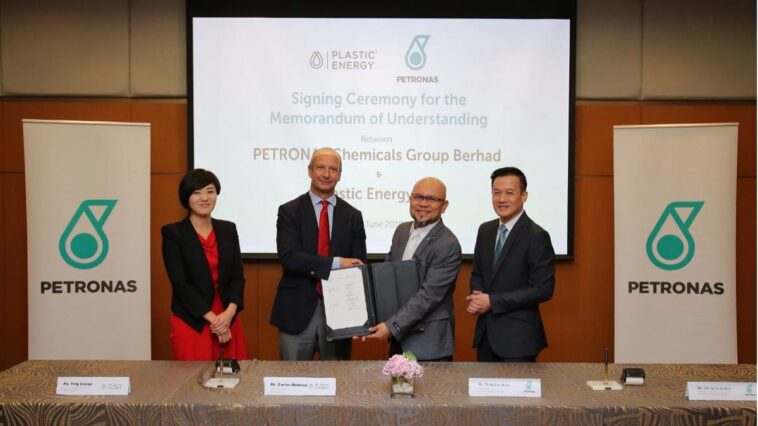
Recognizing the importance of strategic partnerships, PCG has signed a memorandum of understanding (MoU) with Plastic Energy Ltd. The UK-based advanced plastics recycling technology company will help develop a solution that turns non-recyclable plastic waste into naphtha quality pyrolysis oil. This matter can then be made to produce polymers as a feedstock for plastic production, demonstrating the circularity of plastics in motion.
Going a mile further, PCG and Plastic Energy is jointly performing a feasibility study to establish a facility to convert plastic waste into naphtha quality pyrolysis oil. To complement this process, PCG signed an MoU with KDEB Waste Management and One Biosys to enable a constant supply of plastic waste material. Thus, the potential for PCG to offer certified circular polymers is there, presenting a new offering altogether for future responsible plastic application and consumption.
PETRONAS has partnered with Plastic Energy to explore plastic waste conversion into naphtha quality pyrolysis oil within a dedicated facility.
PETRONAS
With such progressive initiatives, PCG has taken a leading role in Malaysia to influence and collaborate with plastic waste operators for plastic waste recovery, segregation and recycling. PCG is also a founding member of the Malaysia Plastic Pact, which drives the implementation of the Malaysia Plastics Sustainability Roadmap.
And the company has no intention of stopping there. “PCG will continue to explore similar opportunities with others who are interested to be part of PCG’s circular economy agenda,” says Yusri, referring to policymakers, small businesses and non-governmental organizations. Apart from ensuring engagement with “everyone in the ecosystem,” this is also “to obtain much-needed support to implement circular economy effectively and holistically,” he says.
Internally, PETRONAS is seeking to engage its operating and business units, including PETRONAS Gas Berhad, to improve the recovery of recyclable materials. Along with the distribution of educational materials in schools and clean-up activities in local communities, PCG is aiming to embed the idea of environmental preservation far and wide.
Some businesses might wonder if plugging into the circularity model is a costly affair. “I think the notion of circular economy solutions being deemed ‘expensive’ needs to be reframed if we are serious about the energy transition,” says Yusri. “Sustainability should be at the heart of an organization’s purpose and strategy, and we need to rethink how we consider value.”
The price of externalities is also a factor for consideration, driving home the need for collaboration in research and technology. “We must be willing to share the risks. Also, we must be practical that adoption will not happen overnight,” adds Yusri.
Augmenting the Renewable Energy Portfolio
Using renewable energy in the circularity model completes the loop. Beyond providing low-carbon fuels such as natural gas, PETRONAS has taken definitive steps toward providing renewable options—a “step-out strategy” into the wider energy space. Its production complexes, MMHE shipyard, Universiti Teknologi PETRONAS, PETRONAS Research Centre, even Suria KLCC, are fitted out with solar photovoltaic systems. And it offers solar technology solutions to clients such as Lotus’s Stores in Malaysia, and to Hilton, Intel and Schlumberger overseas.
Amplus solar farm in Karnataka is India’s largest single-location, open-access solar farm.
PETRONAS
The group has big ambitions to grow in this space, with midterm targets of producing three-gigawatt energy capacity from renewable sources by 2024. In the past three years, the group’s renewable energy capacity has tripled, and there are plans to scale up further, including hydrogen. This paves the way for PETRONAS to realize renewable energy as one of the primary energy sources in their portfolio—yet another important step in the company’s journey toward climate action.

