American Billionaires Fuel Global Soccer’s Reshaping Ahead of 2026 World Cup
While soccer has historically occupied a secondary position in the American sports consciousness, trailing behind established giants like football, basketball, and baseball, a dramatic shift is underway. As the 2026 World Cup prepares to ignite the U.S. sporting landscape, American capital is exerting an unprecedented and increasingly influential role on the global game. This influx of investment from U.S. billionaires highlights a fascinating paradox: domestic fan engagement is soaring, yet American financial muscle has long been deeply embedded in soccer’s worldwide expansion.
These sophisticated investors, ranging from private equity magnates to real estate titans, are increasingly recognizing soccer as one of the most lucrative frontiers in modern entertainment. Over the past two decades, their strategic funding has catalyzed turnarounds, driven expansion, and propelled clubs and players to unparalleled heights. Together, these American owners are not merely investing; they are quietly, yet decisively, reshaping the economic and operational landscape of the world’s most popular sport. This phenomenon signals a maturation of the U.S. soccer market, transitioning from an emerging interest to a significant global player.
Stan Kroenke: The Empire Builder
With a staggering net worth of $22 billion, Stan Kroenke, the 78-year-old Missouri native, commands a vast empire encompassing roughly 60 million square feet of real estate and 1.6 million acres of ranch land, making him one of the largest private landowners in the U.S. He is married to Walmart heiress Ann Walton. His sports portfolio is equally impressive, including the NFL’s Los Angeles Rams, a franchise he controversially relocated from St. Louis in 2016.
Kroenke’s foray into soccer began with the acquisition of the Colorado Rapids in 2004 from fellow billionaire Phil Anschutz. His stake in Arsenal Holdings, the parent company of Premier League giant Arsenal, grew steadily from the early 2000s until he completed a full takeover in 2018. This deal valued the club at £1.8 billion ($2.3 billion) after he bought out minority shareholders, including Alisher Usmanov. The Kroenke family’s ownership of Arsenal, despite initial fan skepticism, has seen a renewed push for sporting success, including significant investment in the squad and a more active role from his son, Josh Kroenke. His multi-sport ownership strategy across different leagues exemplifies a belief in the long-term value appreciation of global sports assets.
Todd Boehly: The Innovator of Financial Strategy
Todd Boehly, the 52-year-old founder of Eldridge Industries, boasts a net worth of $9.3 billion. He made a significant splash in global soccer in 2022 as part of the consortium that purchased Chelsea for $2.15 billion. Boehly briefly served as interim chairman, guiding the club through a transitional period that saw them claim the FIFA Club World Cup in 2025.
His influence extends beyond Chelsea. In 2023, Boehly strategically acquired a majority stake in French Ligue 1 club RC Strasbourg for approximately £65 million ($82 million). This move underscores a growing trend of multi-club ownership (MCO), a model increasingly adopted by savvy investors to create synergies in player development, scouting, and commercial operations across a network of clubs. Boehly is also known for pioneering a unique player recruitment strategy at Chelsea, implementing unusually long-term contracts—often spanning up to eight years—to more efficiently spread costs and manage accounting, demonstrating a sophisticated, private equity-style approach to club management.
John W. Henry: The Data-Driven Modernizer
With a net worth of $5.7 billion, John W. Henry, 76, built his fortune in agricultural futures before establishing John W. Henry & Company in 1981. Through Fenway Sports Group (FSG), he acquired Liverpool in 2010 for £300 million ($476 million), famously rescuing the club from significant debt. Under FSG’s stewardship, Liverpool has enjoyed a remarkable resurgence, securing the Champions League title in 2019 and the Premier League in 2020. The club is now valued at approximately £4.6 billion ($6.5 billion).
However, Henry’s tenure has not been without controversy. In 2021, his backing of Liverpool’s involvement in the ill-fated European Super League drew intense fan backlash, a stark reminder of the unique emotional connection between supporters and their clubs in European football. While FSG’s data-driven approach has been credited with much of Liverpool’s success, particularly in player acquisitions, Henry has faced recurring criticism over his perceived detachment. As Tony Evans of The Athletic’s Walk On podcast observed, “When he’s engaged, things happen. When he’s not, the club drifts,” highlighting the delicate balance required of modern football club ownership between commercial ambition and fan sentiment.
Dan Friedkin: Expanding the European Footprint
Dan Friedkin, the 61-year-old CEO of The Friedkin Group, boasts a net worth of $11.3 billion. His diverse portfolio spans automotive, hospitality, and entertainment. Friedkin expanded his influence in European football by acquiring Italian Serie A club AS Roma in 2020 for €591 million ($700 million). This investment quickly bore fruit, with the club triumphing in the inaugural UEFA Conference League in 2022.
Demonstrating a strategic approach to portfolio growth, Friedkin further expanded his holdings in 2024 by purchasing a 94 percent stake in Premier League club Everton for approximately £400 million ($500 million). This dual-club ownership strategy allows for potential synergies in player transfers, scouting networks, and commercial operations. Friedkin’s past unsuccessful bids for U.S. sports franchises, such as MLB’s San Diego Padres and the NBA’s Boston Celtics, further underscore the significant and growing appeal of European football as a high-value investment for American billionaires.
The Glazer Family: A Legacy of Controversy
The Glazer Family, with a combined net worth of $10 billion, built their fortune through First Allied Corporation, founded by patriarch Malcolm Glazer. Their initial foray into sports ownership was the acquisition of the Tampa Bay Buccaneers in 1995 for $192 million, then an NFL record, which they led to a Super Bowl victory in 2003.
In 2005, the Glazers acquired Manchester United for £790 million ($1.4 billion) in a highly controversial leveraged deal that significantly burdened the club with debt. Following Malcolm Glazer’s passing in 2014, ownership transferred to his six children: Avram, Joel, Kevin, Bryan, Darcie, and Edward. The ownership has consistently faced fan protests due to the financial structuring of the takeover and perceived underinvestment. A pivotal moment occurred in 2024 when British billionaire Sir Jim Ratcliffe purchased a 27.7 percent stake for £1.25 billion ($1.65 billion), assuming control of soccer operations while the Glazers retained majority ownership. This partial divestment signals a potential shift in governance, attempting to balance financial interests with demands for sporting integrity and competitive success.
Jorge Mas: The MLS Visionary
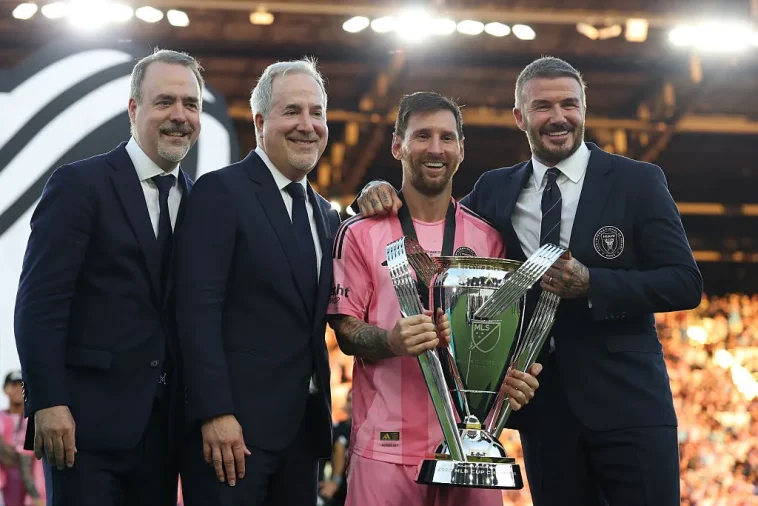
Jorge Mas, the 63-year-old chairman of MasTec, a construction and engineering firm founded by his father, holds a net worth of $4.8 billion. His strategic vision for Major League Soccer (MLS) is particularly evident in his involvement with Inter Miami. He joined David Beckham’s ownership group in 2018 and, alongside his brother José, took majority control in 2021.
Mas’s boldest move was orchestrating the signing of global superstar Lionel Messi in 2023, a seismic event that instantly elevated Inter Miami’s profile and the entire MLS. This “Messi effect” led to the club winning the inaugural Leagues Cup and saw its valuation soar to $1.45 billion, making it the highest-valued franchise in MLS. This demonstrates the profound impact that strategic player acquisitions and celebrity endorsement can have on brand visibility and financial growth within the rapidly expanding American soccer market. Mas also extends his influence to European football as president of Spanish club Real Zaragoza, and remains active in Cuban-American political advocacy. The 2026 World Cup is poised to further accelerate MLS’s commercial growth and fan engagement, building on such high-profile investments.
Other Notable American Billionaires Reshaping Soccer
Beyond these prominent figures, a constellation of other American billionaires is actively shaping the global soccer landscape:
- Shahid Khan (Fulham FC): The Pakistani-American owner of automotive parts supplier Flex-N-Gate, with a net worth of $12.2 billion, acquired Fulham in 2013 for $300 million. His ownership highlights diversification across sports, as he also owns the NFL’s Jacksonville Jaguars.
- Gerry Cardinale (AC Milan): As the founder of RedBird Capital Partners, Cardinale led the $1.2 billion acquisition of Italian Serie A club AC Milan in 2022. This exemplifies the growing trend of private equity firms viewing football clubs as attractive assets for return on investment through operational optimization and strategic growth.
- Bill Foley (AFC Bournemouth, Auckland FC): The Fidelity National Financial chairman, worth $2.6 billion, expanded his sports portfolio by purchasing AFC Bournemouth in 2022 for £120 million ($148 million) through his Black Knight Football Club consortium, which notably includes actor Michael B. Jordan as a minority owner. Foley further embraced the multi-club model by acquiring Auckland FC in 2023, signaling a strategy to build a network of clubs across different leagues.
- Wes Edens (Aston Villa): The Fortress Investment Group founder, with a net worth of $2.5 billion, initially bought a 55 percent stake in Aston Villa in 2018 for £30 million ($39 million) and took full control in 2019 at a £54.5 million ($73 million) valuation. His ownership, alongside Nassef Sawiris, has seen significant investment in the squad, leading to a strong return to European competition.
- Arthur Blank (Atlanta United): The Home Depot co-founder, worth $10.2 billion, was a pioneer in MLS expansion. He launched Atlanta United in 2014, paying a $70 million fee, demonstrating the potential for significant returns and community engagement within a rapidly growing domestic league.
The growing presence of American capital underscores a fundamental belief in the untapped commercial potential of global soccer. This trend is not merely about ownership but about leveraging American business acumen, marketing strategies, and multi-club models to unlock new revenue streams and elevate the sport’s global appeal, particularly as the U.S. prepares to host the world’s premier football tournament in 2026.
#HighEngagement #SocialMedia #MarketingTips #ContentCreator #DigitalMarketing #TrendingNow #EngagementBoost #CommunityBuilding #AudienceGrowth #ViralContent #SuccessStrategies #InstaDaily
Artificial Intelligence, Generative AI, Cloud