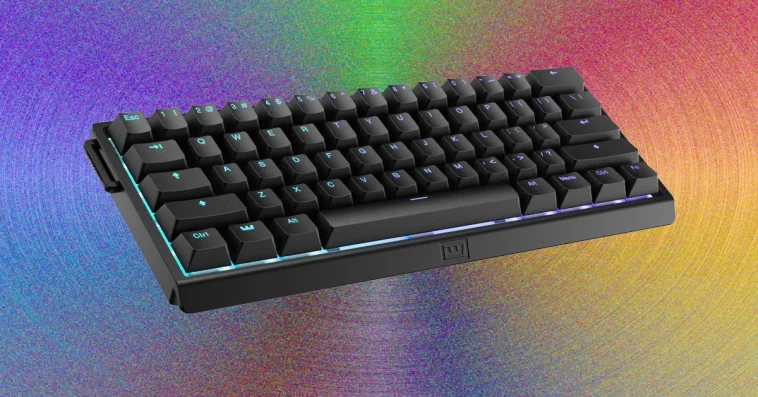
The Wooting 60HE v2: Redefining Competitive PC Input
In the ever-evolving landscape of PC gaming peripherals, few devices have stirred as much discussion and innovation as the Wooting 60HE v2. This keyboard stands out not merely for its robust construction, but for pioneering a level of granular control and customization that challenges conventional input methods, particularly in high-stakes competitive environments.
The Edge of Analog Control
At the core of the Wooting 60HE v2’s performance is its controversial, yet highly effective, Simultaneous Opposing Cardinal Direction (SOCD) customization. This feature allows a single keypress to override an opposing directional input, rather than registering both simultaneously. For tactical shooters like Counter-Strike 2 and Valorant, this translates into an immediate and tangible advantage, enabling precision strafing and “quick peeks” with unparalleled consistency.
The capability to achieve near-zero delay in directional transitions without requiring advanced player skill has sparked considerable debate within esports communities. While offering a distinct competitive edge, its implementation has led to bans in some professional circuits, highlighting the ongoing tension between hardware innovation and fair play regulations. This pushes the industry to re-evaluate the very definition of a “level playing field.”
Unparalleled Customization with Wootility
Beyond its headline-grabbing SOCD functionality, the Wooting 60HE v2 truly shines through the depth of its “Wootility” software. Our extensive testing across a diverse range of genres, from fast-paced shooters to nuanced racing simulations, consistently demonstrated an impressive degree of fine-tuning that simply isn’t achievable with traditional mechanical keyboards. This level of granular control represents a paradigm shift from binary digital inputs to a more analog, expressive interaction.
The ability to precisely calibrate actuation points and customize input behavior opens up new avenues for personalized gameplay and could, in the future, inspire novel mechanics that leverage continuous rather than discrete inputs. This sophistication elevates the user experience, transforming the keyboard from a mere input device into a highly adaptable gaming instrument.
Lekker Switches: Bridging Tactile and Technical
The gaming experience delivered by this keyboard is nothing short of impressive. Its Lekker switches are remarkably smooth and consistent, providing ultra-low-latency inputs and a level of granular control that feels almost intuitive. While earlier Hall Effect keyboard designs from competitors like Keychron and Asus often compromised on tactile feedback, the Wooting’s Lekker switches expertly bridge this gap.
This evolution in Hall Effect technology offers the best of both worlds: the extreme precision and durability inherent in magnetic switches, combined with a satisfying feel that resonates with users accustomed to traditional mechanical designs. This fusion not only enhances gaming performance but also solidifies the keyboard’s appeal for everyday typing.
Aesthetic Customization and Robust Design
Beyond its core performance, the 60HE v2 also offers deep aesthetic customization. Its RGB lighting is vibrant and deeply customizable, allowing users to tailor the visual experience to their preference. While a slight blue bias in the LEDs is a minor quirk, it’s easily corrected within the intuitive software, ensuring true color representation.
This attention to detail in both performance and presentation underscores Wooting’s commitment to a holistic user experience. The integrated software provides comprehensive control, ensuring that both functional and visual aspects are meticulously managed to meet individual user requirements.
A Benchmark for Repairability and Open Standards
One of the most compelling aspects of the 60HE v2 is its exemplary repairability. The keyboard’s thoughtful internal design allows for rapid disassembly, making maintenance and modifications straightforward for users. Despite this ease of access, the construction remains incredibly solid, ensuring all components are securely seated. The internal architecture reveals a clear, modular layout: plate, switches, silicone layer, PCB, and sound dampening.
Furthermore, the 60HE v2 sets a new standard for switch compatibility in analog keyboards. Unlike many competitors from Razer, Keychron, and ROG, which often restrict users to a proprietary handful of options, the 60HE v2 embraces the widely adopted KS-20 design. This open approach allows compatibility with switches from Gateron, Geon, and numerous other manufacturers, providing users with a continually expanding ecosystem of choices and future-proofing their investment. This commitment to open standards is a testament to user-centric design and sustainable hardware.
Design Choices and Future Implications
While adhering to the standard GH60 form factor positions the USB-C port on the left side of the PCB, a minor inconvenience for some who might prefer a centered port on a separate daughterboard, this design choice is pragmatic. The benefits of standardization, both for consumers and third-party accessory manufacturers, ultimately outweigh this minor ergonomic gripe, ensuring broad case and accessory compatibility.
The Wooting 60HE v2 stands as a monumental achievement, performing exceptionally across all metrics. Its robust build quality, smooth and consistent switches, and unparalleled customization options leave virtually nothing to be desired, save for the absence of wireless connectivity. This keyboard is not just a peripheral; it’s a statement about the future of high-performance PC input, delivering an experience that easily positions it among the best gaming keyboards available today. While currently subject to backorder, its $240 price tag represents an investment truly worth the wait for discerning gamers and enthusiasts.
#Innovation #Motivation #Tech #Lifestyle #Fitness #Travel #Inspiration #Entrepreneurship #Success #Mindfulness #Art #Future
Artificial Intelligence, Cloud, Cybersecurity