The Scalpel’s New Hand: Humanoid Robots Usher in a New Era of Surgical Precision
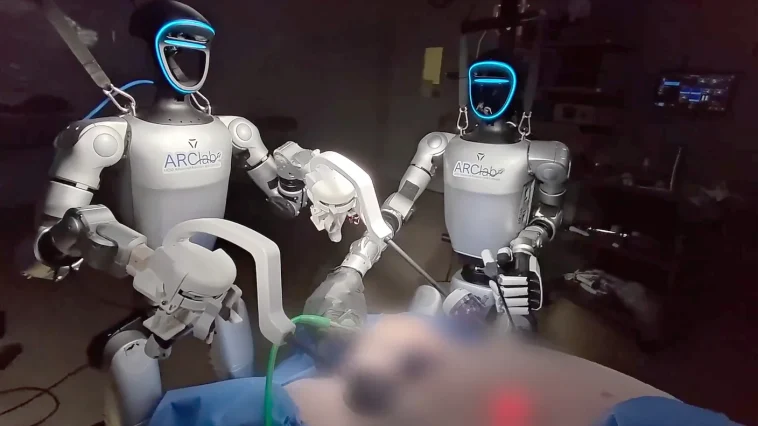
The world of surgical medicine witnessed a historic moment recently as a robot, christened “Surgie,” executed its inaugural incision in a standard surgical setting. With bated breath, medical professionals observed as the humanoid navigated with uncanny precision to an anesthetized pig’s gallbladder, meticulously performing its removal. This landmark event, detailed in a seminal study, marks a profound leap towards integrating humanoid robots as collaborative partners in the intricate domain of minimally invasive surgery.
This pioneering operation, while teleoperated by an expert human surgeon rather than being fully autonomous, fundamentally redefines the scope of robotic assistance in the operating theater. It heralds a future where advanced robotics augment human capability, potentially democratizing access to life-saving procedures on a global scale.
Revolutionizing Access and Efficiency
The implications of this breakthrough extend far beyond the immediate surgical success. According to Michael Yip, a distinguished study author at UC San Diego, remotely operated and autonomous humanoid robots possess “real potential for amplifying access to critical surgeries to which patients would otherwise not have access.” This vision addresses a pressing global challenge: the uneven distribution of surgical expertise and resources.
The study, encompassing two successful surgeries, underscored the robot’s impressive capabilities. Human surgeons remained on standby, ready to intervene in emergencies, yet Surgie completed its tasks with remarkably minimal human intervention. This demonstrated not only the robot’s dexterity but also the robustness of the teleoperation system.
Feedback from the surgeons who controlled Surgie was overwhelmingly positive. They reported a significant reduction in physical strain and frustration, coupled with an overall improvement in performance during the procedures. These immediate benefits highlight the potential for enhanced surgeon well-being and sustained operational excellence, even if practical hurdles like intermittent overheating and the need for frequent repositioning still require refinement.
The Evolution of Surgical Robotics
Robots have been indispensable allies to surgeons for years, significantly advancing the precision and dexterity available for delicate procedures. Particularly in laparoscopic surgery, a minimally invasive technique utilizing tiny incisions to reduce patient pain, accelerate recovery times, and mitigate infection risks, robotic systems have excelled. These specialized machines allow human surgeons to operate with enhanced visual clarity and steadiness, often surpassing what the unaided human eye can perceive.
However, the widespread adoption of these established robotic platforms comes with inherent trade-offs. Systems like Intuitive Surgical’s Da Vinci and CMR Surgical’s Versius, while highly effective, are purpose-built and often demand significant modifications to operating room layouts. Their multi-arm designs necessitate dedicated space for docking and maneuvering, which can be a limiting factor for hospitals with existing infrastructure.
Furthermore, these specialized platforms frequently rely on proprietary surgical instruments and methods. This adds layers of complexity and cost, from the initial investment to ongoing maintenance and staff training, ultimately restricting their deployment in diverse healthcare environments. While systems like Da Vinci 5 offer unparalleled visual fidelity with sharper visuals and improved depth perception, the overall ecosystem can be cumbersome.
Humanoid Robotics: A Paradigm Shift
In stark contrast, humanoid robots like Surgie promise a more adaptable and seamlessly integrated solution. Their human-like form factor offers inherent mobility and compactness, allowing them to navigate and function within conventional operating rooms without extensive modifications. Critically, their design could enable the use of standard surgical instruments, drastically simplifying logistical challenges and reducing the prohibitive costs associated with proprietary tools.
The timing for this advancement is particularly auspicious. Recent technological leaps in electric components have endowed humanoid robots with superior speed and stability, moving them far beyond their once-awkward predecessors. Concurrently, sophisticated AI systems that predict full-body movement and provide real-time feedback have dramatically enhanced robotic balance and their capacity to adapt to the unpredictable complexities of real-world scenarios. These advancements are already evident in other sectors, with humanoid robots actively stocking warehouses and demonstrating advanced locomotion. However, the surgical arena presents an entirely new echelon of demands for precision, reliability, and safety.
Surgie’s Blueprint: Design and Performance
The innovative system behind Surgie comprises a surgeon’s control console linked to the humanoid robot itself. The surgeon, wearing a stereoscopic headset, gains a magnified 3D view of the surgical field, while an input device translates their commands into the robot’s real-time movements. This intuitive interface aims to mimic natural human control, enhancing the surgeon’s sense of presence and control.
For this ground-breaking study, the team selected the commercially available Unitree G1, a general-purpose humanoid robot. Unlike specialized surgical robots, G1’s design features dexterous wrists and multiple joints, making it highly adaptable. The research team further customized the robot’s hands, enabling it to rapidly switch between a variety of surgical tools. Standing just over four feet tall and weighing approximately 77 pounds, Surgie occupies a mere fraction of the physical space required by traditional surgical robots. This compact design is a significant advantage for integrating into existing hospital infrastructure.
Precision is paramount in laparoscopic surgery, where instruments must pivot around a fixed incision point to ensure free movement inside the body without damaging surrounding tissues. After exhaustive mapping of Surgie’s movements, the team successfully identified a safe setup that provided an ample range of motion for most minimally invasive procedures. Surgie subsequently passed standard robotics benchmarks designed to evaluate surgical skill in both human and robotic contexts, proving its fundamental dexterity and control.
Real-World Application and Early Challenges
The ultimate test arrived with two gallbladder removal surgeries performed on live pigs within a standard operating room environment. The operations mirrored typical surgical workflows, involving a lead surgeon and a human assistant to manage the camera, clean lenses, and exchange instruments. In a remarkable display of collaboration, Surgie worked seamlessly with its human counterpart to locate, identify, and remove the gallbladder, minimizing damage to adjacent tissues, including the liver. Intriguingly, during one procedure, a second humanoid briefly took over camera handling, allowing the human assistant to step aside, hinting at a fully robotic support team in the future.
Both operations proceeded with relative smoothness. While one procedure involved minor bleeding and bile leakage, these were easily managed, demonstrating the system’s ability to handle minor complications under human supervision. Surgeons interviewed post-procedure praised the intuitive control of the humanoid robots, particularly appreciating their two-armed configuration and compatibility with standard surgical tools. Nikita Thareja, a study author, expressed surprise at “how well Surgie meshed with our workspace and workflow.”
Despite these successes, the system remains in its early developmental stages, with specific challenges identified. Surgie’s restricted reach necessitated frequent repositioning and recalibration, adding over three minutes to the procedure each time. The robot also required occasional cooling breaks to prevent overheating. In a high-stakes operating room, such interruptions could elevate risks by diverting a surgeon’s attention between the patient and robot supervision. These are critical areas for refinement to ensure seamless integration into clinical practice.
The Future Operating Theater: A Collaborative Vision
Despite these current limitations, the long-term potential of humanoid robots in surgery is immense. Surgie possesses a distinct advantage over conventional surgical robots: its ability to walk. This mobility opens up possibilities beyond direct surgical assistance; it could enable robots to fetch surgical tools, prepare equipment, or even assist in cleaning operating rooms between procedures, significantly boosting efficiency and reducing human workload.
The research team is actively refining the system to mitigate control lag, especially for long-distance teleoperation, which is crucial for remote surgical applications. Furthermore, they are exploring robust methods for safely sterilizing—or “scrubbing in”—a humanoid robot for the operating room, a vital step towards clinical viability.
Yip’s overarching vision is compelling: “Our goal is an operating theater of the future, where humanoid robots and humans work side by side as an integrated team to deliver procedures to those in need, both in traditional hospital settings as well as in non-traditional, field medicine scenarios.” This future, where advanced robotics amplify human capabilities and extend the reach of critical care, is rapidly transitioning from science fiction to tangible reality, promising a profound transformation in global healthcare.
#SocialMediaTips #DigitalMarketing #ContentCreation #TrendingNow #MarketingStrategy #EngagementBoost #AudienceGrowth #ViralContent #CommunityBuilding #OnlineSuccess #BrandAwareness #DigitalTrends
Artificial Intelligence, Generative AI, Cloud