Nvidia’s Vera CPU: A Strategic Masterstroke Beyond GPUs
Nvidia’s recently launched Vera CPU, now actively shipping, is rapidly redefining expectations within the competitive data center landscape. While initially spotlighted for its unparalleled efficiency and performance in burgeoning agentic AI workloads, its impact extends far beyond, carving out significant traction in diverse segments due to its exceptional memory bandwidth, stellar power efficiency, and robust single-core performance. This development signals a profound shift in Nvidia’s comprehensive strategy, positioning the company as a formidable full-stack compute provider. (It is important to note that Nvidia, like many leading AI semiconductor innovators, is a client of my firm, Cambrian-AI Research.)
Vera CPU Redefines Agentic AI Performance
The resurgence of CPUs in the era of artificial intelligence, particularly for agentic AI, is a critical industry trend. Agentic workloads demand fast, efficient CPU cores and high-throughput memory to plan and execute sequential tasks in iterative loops, often hundreds of times over. In this paradigm, the velocity of individual cores and the ability of memory to keep pace are paramount, often outweighing raw core count.
Nvidia’s Vera CPU directly addresses this challenge. Traditional cloud architectures, optimized for parallel processing, often see expensive GPUs idling while waiting for slower CPUs to complete each step of an agentic loop. Vera’s design philosophy prioritizes lightning-fast single-threaded core performance and highly efficient inter-core communication, meticulously engineered to avoid performance bottlenecks inherent in multi-chiplet boundaries.
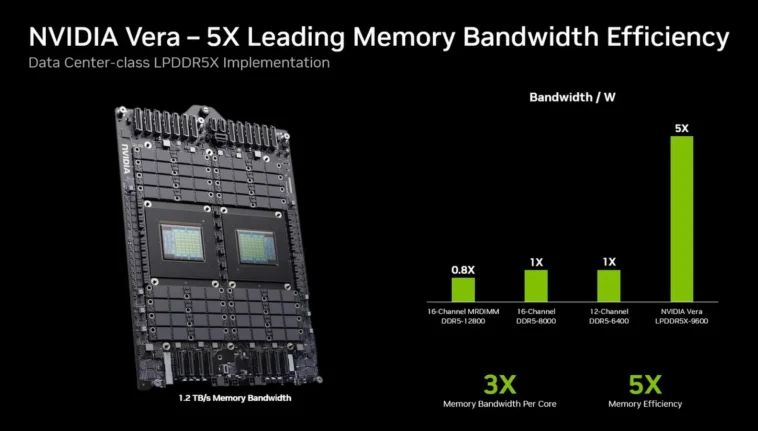
This architectural ingenuity translates into significantly faster task completion and reduced latency, directly improving overall data center efficiency. The integration of LPDDR5X memory, originally developed for mobile devices, is a game-changer. It delivers five times the memory bandwidth efficiency of prior generations, enabling the CPU to feed its powerful cores with data at an unprecedented rate while simultaneously achieving superior power efficiency. This not only accelerates AI inference but also enhances profitability for cloud providers and enterprises deploying agentic solutions.
The Strategic Business Imperative for Vera
The market potential for Vera is substantial and aggressively projected. Analysts estimate Nvidia could ship between four and five million Vera CPUs in the latter half of 2026, a significant increase over the 2.5 million Grace CPUs shipped to date. Bank of America projects this could generate upwards of $20 billion in revenue for Nvidia in 2026, with stand-alone CPU sales potentially accounting for half of that sum.
Public reports indicate a price point “well north of $20,000” per processor before volume discounts. A fully equipped rack, featuring 256 Vera chips, is estimated to cost around $10 million, suggesting an effective price range of $30,000 to $40,000 per processor when factoring in memory and system components. Nvidia itself has boldly declared the Total Addressable Market (TAM) for its Rubin platform, which includes Vera, to be a staggering $200 billion opportunity. This aggressive financial outlook underscores Nvidia’s intent to become a dominant force in the broader server CPU market, challenging established incumbents.
Expanding Horizons: Vera’s Impact Beyond AI Agents
Vera’s capabilities are proving transformative across a spectrum of demanding applications, far exceeding its initial focus on agentic AI. Leading generative AI firm Perplexity, an Nvidia investment, has already reported a remarkable 1.5x to 1.9x performance improvement using Vera compared to x86 CPUs in agentic AI workloads. This validates Vera’s core strength in its intended domain.
However, the surprises continue. The New York Stock Exchange (NYSE) has witnessed an astounding six-fold improvement in P99 latency with Vera. P99 latency, which measures the response time of the slowest 1% of requests, is a critical metric in high-frequency trading and other latency-sensitive financial operations. Vera’s monolithic architecture and consistent performance are proving invaluable in maintaining market integrity and speed.
Furthermore, in the realm of scientific simulation and High-Performance Computing (HPC), Los Alamos National Labs is experiencing three to seven times better performance with Vera CPUs and Rubin GPUs in their Veritas supercomputer. This profound acceleration in complex scientific models highlights Vera’s superior per-core performance and prodigious memory bandwidth, enabling breakthroughs in fields from climate modeling to materials science. The rapid adoption by these diverse, high-profile customers underscores the broad applicability and compelling value proposition of the Vera CPU, solidifying Nvidia’s burgeoning ecosystem across supercomputing centers, cloud providers, and system OEMs.
Nvidia’s Strategic Evolution: A Full-Stack Powerhouse
The introduction and rapid adoption of the Vera CPU represent a pivotal moment in Nvidia’s strategic trajectory. It empowers Nvidia to assert a definitive technological lead across every critical segment of the data center compute business. With top-tier, differentiated platforms encompassing rack-scale systems, CPUs, GPUs, LPUs, and networking solutions of all scales – from intra-node to inter-rack and global – Nvidia now offers an unparalleled, comprehensive ecosystem.
This strategic expansion positions Nvidia to directly address the colossal $200 billion server CPU TAM, wielding an exceptionally strong hand against entrenched competitors. By offering a complete and optimized compute stack, Nvidia is not merely participating in the data center market; it is actively reshaping it, promising a future where seamless integration and unparalleled performance drive the next wave of technological innovation.
#trending #viral #explore #fyp #instadaily #love #inspiration #motivation #success #mindset #lifestyle #goals
Artificial Intelligence, Cloud, Cybersecurity