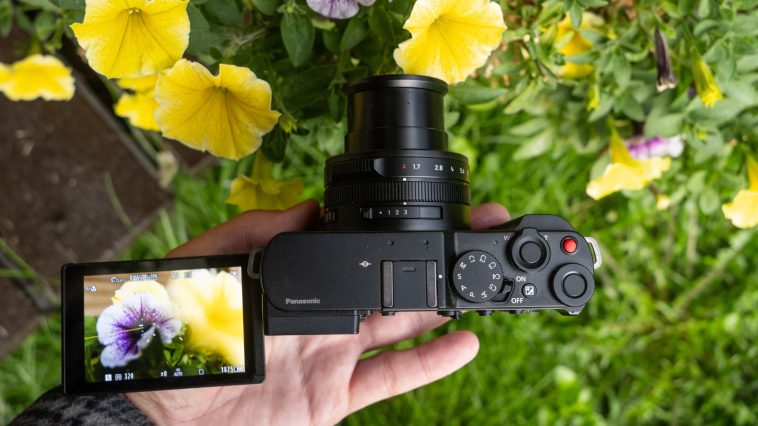
Panasonic Lumix L10: A Formidable Contender in the Resurgent Compact Camera Market
The digital camera market, once widely considered to be in a “doom spiral” due to smartphone ubiquity, has witnessed an unexpected and vibrant resurgence. This revival, notably spurred by trending social media platforms like TikTok, has reignited demand for dedicated compact cameras. Users are increasingly seeking improved image quality and a more tactile shooting experience that smartphones simply cannot replicate. While models like Fujifilm’s iconic X100 VI, Ricoh’s GR series, and offerings from Leica have captivated enthusiasts with their fixed prime lenses, Panasonic has entered the fray with a compelling alternative: the Lumix L10. This 20.3-megapixel compact camera differentiates itself with a versatile 24-75mm equivalent zoom lens, aiming to be the practical choice for a broader spectrum of users.
Priced at $1,500, the Lumix L10 is positioned as the successor to the acclaimed LX100 II, yet it brings a host of significant internal and external upgrades. During a rigorous field test in northern Canada, the L10 proved its mettle, demonstrating that its zoom lens is not merely a convenience but a genuinely empowering feature for capturing diverse moments, from candid events and dynamic parties to expansive travel scenes. Its ability to deliver consistently excellent photos and videos, coupled with swift performance, marks it as a serious contender, despite a price point that aligns with other premium compacts in its class.
Redesigned Ergonomics and Intuitive Controls
The Lumix L10 presents a more substantial build than its predecessor, the LX100 II, tipping the scales at 508 grams. While this makes it slightly less pocketable, the increase in heft contributes to a more solid, premium feel in hand. Its thoughtful design includes a small yet adequately deep grip, providing a secure hold that inspires confidence during extended shooting sessions.
Panasonic has struck a commendable balance between manual control and user-friendliness. The L10 features dual command dials on the top and rear for rapid setting adjustments, alongside a dedicated switch for photo, video, and S&Q (slow and quick) modes. A dozen programmable buttons offer extensive customization, allowing photographers to tailor the camera to their specific workflow. Notably, a four-step aspect ratio switch offers creative flexibility for in-camera cropping, catering to those who prefer immediate, ready-to-share JPEGs. The omission of the LX100’s separate shutter speed and exposure compensation dials streamlines the interface without compromising essential control.
At the heart of the L10’s versatility is its 24-75mm f/1.7-2.8 equivalent Leica zoom lens, a well-regarded optic inherited from the LX100 II. This lens remains impressively fast and sharp across its zoom range, capable of focusing down to a remarkable 3 cm in macro mode at its widest setting. This makes it an exceptional tool for capturing intricate details of flora and fauna, expanding its utility beyond general-purpose photography.
Further enhancing its usability is a fully articulating 1.8-million-dot rear display, a significant upgrade over the LX100 II’s fixed screen. This articulation vastly improves the camera’s utility for video recording, high- and low-angle shots, and self-portraits. While its 2.34-million-dot electronic viewfinder (EVF) may not boast the absolute highest resolution, its inclusion is a welcome feature, providing a critical compositional aid, particularly in bright conditions, a clear advantage over some rivals.
Unique for a compact camera, the L10 utilizes a full-sized DMW-BLK22 battery, shared across many Panasonic models. This ensures outstanding battery life, rated for 420 shots or up to an impressive 1,000 in power-saving mode, alongside 100 minutes of 4K 60p video recording per charge. This commonality with other Panasonic systems also simplifies battery management for multi-camera users. Furthermore, a dedicated, easily accessible SD UHS-II slot underscores Panasonic’s commitment to practical design and efficient workflow.
Unleashing Unparalleled Performance
The Lumix L10’s most profound advancements lie beneath the surface, driven by a new sensor and image processor. It incorporates a slightly cropped version of the 26.5-megapixel Four Thirds sensor found in the high-performance G9 II, propelling its maximum resolution to a crisp 20.3MP, a noticeable leap from the LX100 II’s 17MP. This increase in resolution provides greater detail and flexibility for cropping in post-production.
Speed is a defining characteristic of the L10. It boasts impressive burst shooting rates of 9 frames per second (fps) with continuous autofocus using the mechanical shutter, or a blistering 30 fps in electronic mode. These speeds significantly surpass the LX100 II’s 5.5 fps and even outpace many direct competitors, including the Sony RX100 VII (20 fps max) and the Fujifilm X100 VI (20 fps), marking the L10 as a potent tool for capturing fast-moving subjects.
Crucially, this speed is matched by exceptional autofocus reliability. Unlike its predecessor’s contrast-detect system, the L10 leverages Panasonic’s advanced phase hybrid AF with 779 points. This sophisticated system, akin to those found in Panasonic’s higher-end mirrorless cameras, delivers substantially faster and more accurate subject tracking in continuous AF mode. This translates to a higher keeper rate, especially when photographing dynamic scenes or unpredictable wildlife.
The L10’s AI subject recognition further enhances its focusing prowess, reliably locking onto humans, animals (including dogs and deer in testing), and vehicles. While intricate forest environments occasionally posed minor challenges, the system generally performed admirably, demonstrating the ongoing advancements in computational photography. For close-up enthusiasts, the dedicated macro switch provides effortless access to sharp imagery from nearly an inch away, as vividly demonstrated by captivating shots of dragonflies and wildflowers during testing.
While the L10 incorporates optical lens shake reduction, it notably lacks in-body image stabilization (IBIS). This lens-only stabilization proves effective for mitigating camera shake at slower shutter speeds, down to approximately a fifth of a second. However, for demanding video applications or situations requiring aggressive stabilization during motion, its capabilities are somewhat limited, a point of consideration for hybrid shooters.
Exemplary Image Quality and Creative Latitude
The Lumix L10 empowers photographers with unique creative options, including a dedicated switch for selecting four distinct aspect ratios: 4:3, 3:2, 16:9, and 1:1. While many professionals prefer to capture the full sensor area and crop later, this feature is invaluable for those who prioritize immediate JPEG output for rapid sharing, streamlining the creative process.
Further enhancing in-camera creativity is the “LUT” (Look Up Table) button. Beyond Panasonic’s extensive suite of preset photo styles, such as L.ClassicGold and Leica Monochrome, users can download or create their own custom LUTs via Panasonic’s Lumix Lab app. These personalized looks can then be applied in real-time, offering unparalleled control over the final aesthetic directly within the camera, bridging the gap between capture and creative vision.
Thanks to its updated sensor, the L10 produces notably sharper photos with reduced noise at lower ISOs compared to the LX100 II. The increased resolution also affords greater flexibility for cropping without a significant loss of detail. Out-of-camera JPEG colors are vibrant and accurate, often requiring minimal post-processing, making the L10 an excellent choice for those who value efficiency.
The dual-gain sensor contributes to surprisingly strong low-light performance for a Micro Four Thirds camera. Noise remains well-controlled and minimal up to ISO 2,500, and is effectively managed even at higher sensitivities, up to ISO 12,800. While a smaller sensor inherently benefits from ample light, the L10’s performance in challenging conditions is commendable.
For those who prefer extensive post-processing, RAW files from the L10 offer considerable latitude for adjusting highlights and recovering shadow detail. While not on par with larger full-frame sensors in extreme scenarios, the flexibility provided is more than adequate for most real-world shooting. The L10 also introduces an automatic dynamic range boost function, combining high and low-gain circuits in an HDR-like fashion. This intelligent feature is particularly beneficial in high-contrast lighting, preserving detail in both bright skies and deep shadows.
Versatile Video Capabilities for the Modern Creator
While Panasonic positions the L10 primarily as a photography tool, its video capabilities are remarkably robust for a compact camera. It can capture stunning 5.6K video at up to 60 fps, with both 10-bit color and V-Log profiles available to maximize dynamic range, offering significant grading potential in post-production. For high-speed applications, 4K video can be recorded at up to 120 fps. The camera supports both I-frame capture for simpler editing workflows and long-GOP for efficient file sizes, catering to different production needs.
The L10’s compact form factor and lack of an active cooling fan do impose limitations on recording times. Users can expect approximately 10 minutes of 4K 60 fps video before overheating, or 20 minutes of 4K 30 fps. While this precludes it from being a primary camera for extended, uninterrupted shoots like weddings, it remains highly capable for short-form content, vlogging, and capturing specific moments.
The advanced phase-detect autofocus system translates seamlessly to video, virtually eliminating the “hunting” issues prevalent in the LX100 II. This ensures smooth, reliable subject tracking, a critical factor for professional-looking video. Furthermore, the L10 boasts a low 500 ISO floor for dynamic range-boosted V-Log recording, a notable improvement over the GH6’s ISO 2,000. This lower base ISO makes the L10 considerably more practical for shooting V-Log in bright sunlight, where the benefits of increased dynamic range are most pronounced.
As noted earlier, video stabilization is an area where the L10, without IBIS, exhibits some limitations. The optical lens stabilization performs adequately for casual handheld shooting, but aggressive camera movements may result in noticeable jerks. While electronic stabilization offers further smoothing with a slight crop, it’s insufficient for complex movements like walking and talking, suggesting that a gimbal would be beneficial for serious motion-heavy video work.
The Lumix L10: A Smart Investment in Premium Compact Photography
The Panasonic Lumix L10 transcends expectations, proving itself to be far more than just a stylish travel companion. Its image quality, even in challenging low-light conditions, is impressively refined, and its overall performance is exceptionally strong. The video capabilities, while limited by thermal constraints for extended recording, exceed what one might anticipate from a camera of this class.
At its launch price of $1,500, the L10 initially appears to sit at the higher end of the compact camera spectrum, especially compared to the LX100 II’s initial $1,000 tag. However, a closer look at the competitive landscape reveals that this pricing is highly competitive. Rivals such as Sony’s RX100 VII, also priced around $1,500, and the $1,800 Fujifilm X100 VI, demonstrate similar premium positioning.
The X100 VI certainly offers a more robust build and a larger APS-C sensor, appealing to those who prioritize ultimate image fidelity in a fixed-lens system. However, the L10 counters with faster shooting speeds and significantly more capable video features, making it a stronger hybrid tool. Sony’s RX100 VII, while offering an extended 24-200mm f/2.8-4.5 zoom, utilizes a smaller 1-inch sensor, which can be a compromise for image quality in dimmer conditions.
Ultimately, the Lumix L10 distinguishes itself through superior handling, thanks to its well-placed manual controls and the versatile flip-out rear display. Its responsiveness surpasses both its primary rivals, offering a more immediate and satisfying user experience. For photographers seeking a powerful, stylish, and remarkably capable compact camera that balances zoom versatility with high-end imaging and video, the L10 stands out. Available in sleek black, sophisticated silver, or elegant platinum, it presents a compelling argument for serious enthusiasts and creative professionals alike.
#TrendingNow #ExplorePage #Viral #ForYou #InstaDaily #Motivation #GoodVibes #LifeHacks #Inspiration #TravelGram #FitnessGoals #TechGadgets
Artificial Intelligence, Cloud, Cybersecurity