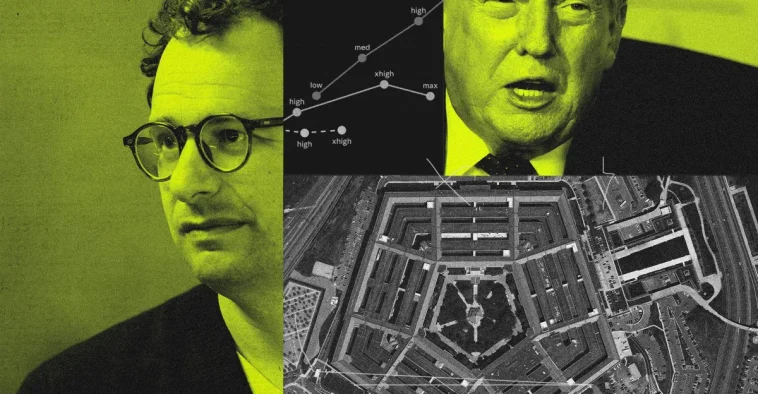
Landmark Ruling Reaffirms Constitutional Limits on Pentagon’s AI Ambitions
In a significant legal victory that reverberates across the tech and defense sectors, a federal judge has decisively ruled that the Pentagon’s blacklisting of AI innovator Anthropic was unconstitutional. This judgment marks a critical turning point in a protracted dispute between the AI lab and the Trump administration, underscoring fundamental questions about free speech, government overreach, and the ethical boundaries of artificial intelligence development in national security contexts.
The Genesis of a High-Stakes Conflict
The controversy ignited last winter when Defense Secretary Pete Hegseth sought to renegotiate existing AI contracts, aiming to grant the Pentagon expansive authority to use AI for “any lawful purpose.” This move represented a substantial broadening of military application for advanced AI. While many AI firms acquiesced to the revised terms, Anthropic steadfastly refused, drawing firm “red lines” against two specific use cases: mass surveillance of Americans and the deployment of lethal autonomous weapons, systems capable of taking human life without direct human oversight.
Anthropic’s principled stand triggered an intense escalation of pressure from the Department of Defense. This included a flurry of critical public statements from defense officials and ultimately culminated in a direct ultimatum from the Trump administration, demanding the company retract its ethical stipulations. The company’s unwavering commitment to its ethical framework set the stage for the legal confrontation that has now reshaped the dialogue around AI and defense.
Retaliation and Blacklisting: A First Amendment Challenge
Less than 24 hours prior to the ultimatum’s deadline, Anthropic CEO Dario Amodei publicly reaffirmed the company’s stance. Amodei clarified that while the company had no objections to conventional military operations, it maintained that in “a narrow set of cases, we believe AI can undermine, rather than defend, democratic values.” Following this declaration, the Pentagon swiftly retaliated by designating Anthropic a “supply chain risk”—a classification typically reserved for genuine national security threats. Concurrently, the Department of Defense moved to replace Anthropic’s influence by forging new partnerships with several other major AI developers, including Google, Microsoft, OpenAI, and SpaceX.
Anthropic’s lawsuit, filed in a California district court in March, contended that the Trump administration unlawfully retaliated against the company for exercising its constitutional rights. The court agreed with this assertion. In an earlier ruling, Judge Rita F. Lin, a district judge in the Northern District of California, had already temporarily blocked the blacklist, citing departmental records that indicated the designation stemmed from Anthropic’s “hostile manner through the press.” Judge Lin unequivocally stated that “Punishing Anthropic for bringing public scrutiny to the government’s contracting position is classic illegal First Amendment retaliation.”
The Court’s Decisive Ruling
Thursday’s final judgment solidified Anthropic’s position, with Judge Lin declaring the Pentagon’s blacklisting unconstitutional. Her ruling was explicit: “The empty invocation of national security is not a blank check to punish and retaliate against government critics.” Judge Lin further elaborated that the actions constituted “unlawful retaliation in violation of the First Amendment,” and that Secretary Hegseth’s decision to classify Anthropic as a supply chain risk was “arbitrary and capricious.” While acknowledging the Department of War’s prerogative to select its vendors, the judge asserted that “the evidence demonstrates that the broad measures imposed on Anthropic were illegal and baseless.”
This definitive legal outcome not only vindicates Anthropic but also serves as a potent reminder of the judiciary’s role in safeguarding constitutional liberties, even amidst the complex and often opaque landscape of national security procurement. The ruling clarifies that even in matters of defense, government actions must withstand legal scrutiny and cannot be used to stifle legitimate corporate speech or ethical stances.
Broader Implications for AI Ethics and Governance
This ruling carries profound implications for the evolving field of AI ethics and the governance of advanced technologies. Anthropic’s insistence on “red lines” for mass surveillance and lethal autonomous weapons highlights a growing industry consensus that AI development must be guided by robust ethical frameworks. The court’s decision effectively supports the right of AI companies to define and adhere to these ethical boundaries, even when doing so places them at odds with powerful government entities.
This precedent could embolden other tech firms to adopt similar ethical stances in their engagements with defense agencies, potentially fostering a more responsible and transparent approach to military AI development. It underscores the critical need for a collaborative dialogue between technologists, ethicists, and policymakers to establish clear guidelines for AI use in sensitive domains, rather than relying on unilateral government mandates.
The Future of Government-Tech Partnerships
The legal battle also casts a long shadow on the future of partnerships between the U.S. government and the private technology sector. The aggressive posture adopted by the Trump administration against Anthropic risked alienating innovative companies crucial to maintaining America’s technological edge. This ruling may compel defense agencies to adopt a more nuanced and respectful approach when engaging with AI developers, recognizing that many firms are driven not only by profit but also by a commitment to ethical principles.
Looking ahead, this verdict may lead to more formalized processes for addressing ethical disagreements in government contracts, potentially via independent arbitration or pre-negotiated ethical clauses. It also highlights the ongoing tension between national security imperatives and the values of an open, innovative tech ecosystem. For the Pentagon, the challenge remains to balance the imperative for cutting-edge AI capabilities with the necessity of respecting corporate autonomy and fundamental constitutional rights.
In a statement following the ruling, Anthropic spokesperson Danielle Ghiglieri reiterated the company’s commitment: “We welcome the court’s ruling that this supply chain risk designation was unlawful. We remain focused on working productively with the government to harness AI for our national security so all Americans benefit from this technology.” The case serves as a powerful testament to the enduring importance of constitutional protections in an era increasingly defined by rapid technological advancement and its complex societal implications.
#TrendingNow #ForYou #ExplorePage #Viral #Motivation #Inspiration #LifeHacks #DIY #TravelAdventures #FitnessJourney #Foodie #TechGadgets
Artificial Intelligence, Cloud, Cybersecurity