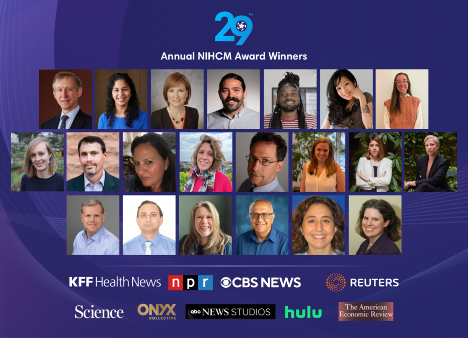
The NIHCM awards are meant to celebrate storytelling that helps spark policy change.
When Nancy Chockley became founding executive director of a new health policy non-profit, one of her first actions was establishing a set of awards to spotlight storytellers – journalists and researchers – whose work pointed the way towards health system change.
Nearly three decades later, the award categories, prize money and prestige have all grown, while the National Institute for Health Care Management (NIHCM) annual awards dinner has become a rare example of a bipartisan Washington event where individuals with very different viewpoints and jobs mix amicably and actually listen.
“It’s meant to bring together smart people doing quality work with different perspectives and different areas of expertise,” said Chockley in an interview. “I want NIHCM to be a positive force.”
To achieve that goal, NIHCM’s consistent focus has been evidence, not ideology. A quote on the NIHCM website from Bob Kocher, a prominent venture capitalist and a former senior adviser to President Obama, characterizes the organization’s place in the policy ecosystem.
“They’re not a lobbyist, they’re not an association, they’re not a partisan institution and they’re trusted,” Kocher says.
As someone who’s been involved in both journalism and research, and as a longtime judge for NIHCM’s digital media category, I can attest to NIHCM’s unique process.
First, to keep the quality of entries high, NIHCM staff regularly pores over articles that could become entries and then reaches out to tell the authors about the NIHCM contest. Over the years those efforts have paid off. This past year there were almost 500 entries in five categories.
“The award is generally well known,” David Cutler, the lead author of this year’s Research Award, told me in response to an emailed question.
“I consider it quite prestigious,” added Cutler, a Harvard economics professor whose numerous health policy accomplishments render him eminently qualified to evaluate prestige.
Second, the judges are a diverse and independent group of experts, which sends an important signal to would-be entrants. Moreover, although NIHCM was founded by leaders of a group of progressive Blue Cross and Blue Shield plans, a consistent criterion is well-researched, compelling work that sparks discussion and influences “health care policy” – not “health insurance policy” or some thinly disguised agenda.
Fred Schulte of KFF Health News, known as one of the country’s top investigative reporters, is a three-time NIHCM award winner who’s also been a judge in the trade and general circulation categories. In response to my questions, he related the same kind of experience I’ve had as a “screener” in my award category.
“The competition just to make the list of 10 finalists is brutal,” Schulte wrote. “There has been some phenomenal, groundbreaking work.”
Finally, NIHCM recognizes outstanding achievement with both Lucite and lucre. In addition to plaques, there’s a $15,000 prize in trade journalism and a $20,000 prize in each of the other categories, which typically involve multiple team members. Separately, NIHCM also gives $1 million in grants to journalists and researchers annually.
“We’re trying to help people see the full picture of health care,” says Chockley, “to tell the personal stories and also get the research.”
A listing of 2023 winners with links to the winning entries can be found on the NIHCM website. As with great fiction, superb nonfiction storytelling is not necessarily accompanied by an immediately comprehensible title. This year’s “Thank You for a Title I Can Understand” prize goes to the Digital Media Award winner, “Diagnosis: Debt.” With dazzling digital savvy, this 10-part series, a collaboration among KFF Health News, NPR and CBS News, spotlighted the suffering and sacrifices of the startling 100 million Americans struggling with (yes) medical debt.
Meanwhile, the “I Have No Clue What This Title Means” Award goes, of course, to the winning Research Award. In a paper entitled “A Satellite Account for Health in the United States” and published in the American Economic Review, the authors lay out an accounting framework to answer a crucial question: whether the nation’s steady increase in health spending is yielding concomitant gains in health. The judges called it “a brilliant breakthrough.”
Other NIHCM winners that relate extraordinary stories but have titles that require engaging with their work to understand, include:
- “Blots on a Field,” by Science magazine, winner of the Trade Award. This a shocking, in-depth investigation of possible fraud in a key area of Alzheimer’s research that has led medical investigators down a wrong path for 20 years.
- “Youth in Transition,” winner of the General Circulation Award. This four-part Reuters series explored the sensitive issue of gender-affirming medical care for children in a respectful, balanced way that combined personal stories and reviews of the scientific literature.
- “Aftershock,” winner of the Television and Radio Award. This documentary produced by the Onyx Collective, ABC News Studio and Hulu combined scientific evidence with emotionally powerful personal stories to highlight the ripple effects of the shockingly high level of maternal mortality among Black women.
A recent article in The Economist related how ChatGPT could be used to assess the newsworthiness of research papers and how artificial intelligence as a whole might be deployed to change the very nature of journalism. In that context, NIHCM is decidedly old-fashioned.
“NIHCM awards are meant to reward not the most clicks, but the deepest thinking and the best-researched articles,” Chockley says.