Spectacular Aurora Borealis Expected as Geomagnetic Storm Looms
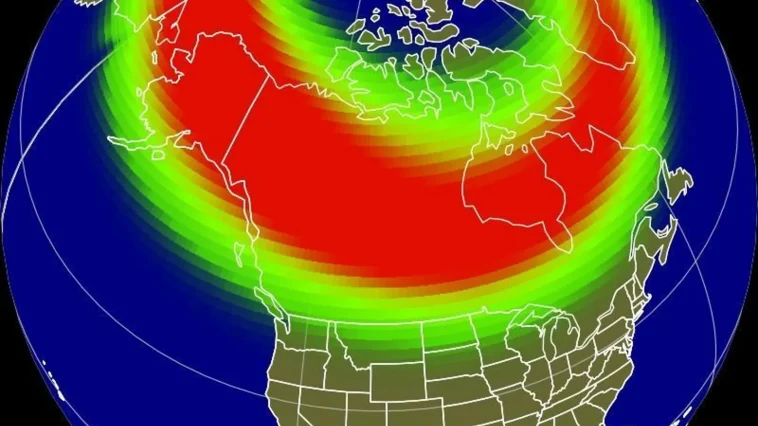
Following an impressive recent display, skygazers across northern U.S. states and Canada are once again on alert for the captivating aurora borealis. Forecasters at the National Oceanic and Atmospheric Administration (NOAA) anticipate a G1 geomagnetic storm to potentially strike overnight from Friday, May 15, through Saturday, May 16. The timing is particularly opportune, as a new moon on Saturday ensures minimal light pollution, optimizing conditions for viewing even fainter auroral curtains.
Coronal Hole Fuels Anticipated Display
This celestial spectacle is attributed to a coronal hole, a significant breach in the sun’s outermost atmospheric layer, the corona. Such gaps allow high-speed solar wind to escape directly towards Earth. This stream of charged particles, upon interacting with our planet’s magnetic field, can trigger geomagnetic storms. As these energized particles are funneled down Earth’s magnetic field lines at the poles, they excite atmospheric gases, producing the iconic green and red auroral ovals. This phenomenon underscores the intricate dance between our star and our planet’s protective magnetosphere.
Prime Viewing Zones and Escalating Potential
A G1-class geomagnetic storm holds the potential for visible aurora across a wide swath of northern latitudes. States such as Alaska, Washington, Idaho, Montana, North Dakota, South Dakota, Minnesota, Wisconsin, Michigan, and Maine are positioned for possible sightings, likely on the northern horizon.
Should solar activity intensify and lead to a more potent G2-class geomagnetic storm, the auroral oval could expand significantly. This would bring the mesmerizing lights within reach of states further south, including Oregon, Wyoming, Nebraska, Iowa, Illinois, Indiana, Ohio, New York, Vermont, and New Hampshire, dramatically increasing the potential audience for this celestial phenomenon.
Heightened Solar Activity Drives Displays
After a period of relatively low solar activity, the sun has shown increasing dynamism. An M2-class solar flare on May 7 signaled the emergence of a newly active sunspot region. Solar flares, powerful eruptions of electromagnetic radiation, originate from complex, twisted magnetic fields often found above sunspots – cooler, darker areas on the sun’s surface. This flare was followed by several coronal mass ejections (CMEs), which are colossal clouds of charged particles. When these CMEs are directed toward Earth, they can significantly enhance the likelihood and intensity of geomagnetic storms. Such events are characteristic of the sun’s journey toward its solar maximum, promising more frequent and potentially more spectacular auroral displays in the coming years.
The Science of Aurora Forecasting
Predicting the aurora relies on a nuanced understanding of solar dynamics. The sun’s approximately 27-day rotation is a crucial factor, as it periodically brings active, aurora-producing sunspot regions into Earth’s view. NOAA’s forecasts, like the recent prediction of “Active to G1 (Minor) storm levels” due to “lingering CH HSS influences” (coronal hole high-speed solar stream), highlight the continuous monitoring required. Further active periods are anticipated on May 18, May 23, and May 27 as other active regions rotate into alignment.
Accurate, immediate forecasting hinges on data from satellites like NOAA’s DSCOVR, positioned a million miles from Earth. DSCOVR measures the solar wind’s speed and magnetic intensity, providing vital insights into its imminent impact on Earth’s magnetosphere. This allows the Space Weather Prediction Center to issue precise aurora forecasts, though often with a limited lead time of approximately 30 minutes. Advancements in space weather modeling promise to extend this warning window, offering amateur astronomers and photographers more time to prepare for these ephemeral events.
Real-time Tracking and Key Indicators
For dedicated aurora chasers, understanding specific space weather metrics is paramount. While the Kp index broadly indicates geomagnetic storm intensity, the interplanetary magnetic field’s Bz component is often more critical for predicting aurora visibility. Bz indicates the direction of the magnetic field carried by the solar wind. A sustained southward Bz (typically -5 nT or stronger) signifies that the solar and Earth’s magnetic fields can connect, allowing solar plasma to stream into our magnetosphere and ignite the aurora.
Key takeaways for tracking the aurora:
* Monitor NOAA’s 30-minute aurora forecast for real-time visibility predictions.
* Utilize dedicated aurora apps such as Aurora Now, My Aurora Forecast, or Glendale Aurora for live solar wind data and alerts.
* Prioritize locations with minimal light pollution and a clear view of the northern horizon.
As the cosmos continues its dynamic interplay, those who venture out under the darkened sky this weekend may be rewarded with one of nature’s most breathtaking and ethereal light shows.
Northern Lights Friday: 10 States in Aurora Strike Zone
#TrendingNow #Innovation #FutureIsNow #TechSavvy #DigitalLife #AIRevolution #StayCurious #GlobalImpact #CreativeMinds #DailyInspiration #LearnSomethingNew #MindfulnessMatters
Artificial Intelligence, Software Engineering, Data Science