Revolutionizing Enterprise AI: June Emerges to Tackle the Integration Conundrum
The promise of artificial intelligence within the enterprise remains immense, yet its full realization has been hampered by a formidable challenge: reliable implementation. Big businesses frequently find themselves grappling with the complexities of integrating AI tools into their intricate, often legacy-laden systems. This persistent struggle has ironically fueled the rise of a new breed of specialists – forward-deployed engineers (FDEs) – who parachute into organizations to manually bridge the gap between AI capabilities and operational reality.
“AI, paradoxically, increases the demand for professional services,” notes Efrat Rapoport, a former Salesforce executive and co-founder of June. This observation underscores a fundamental disconnect: while AI aims to automate, its current deployment often necessitates an exhaustive human effort. The industry’s conventional response has been to “hire more and more and more people,” a strategy that is proving unsustainable and inefficient for many large corporations.
June’s Vision: Automating AI Implementation
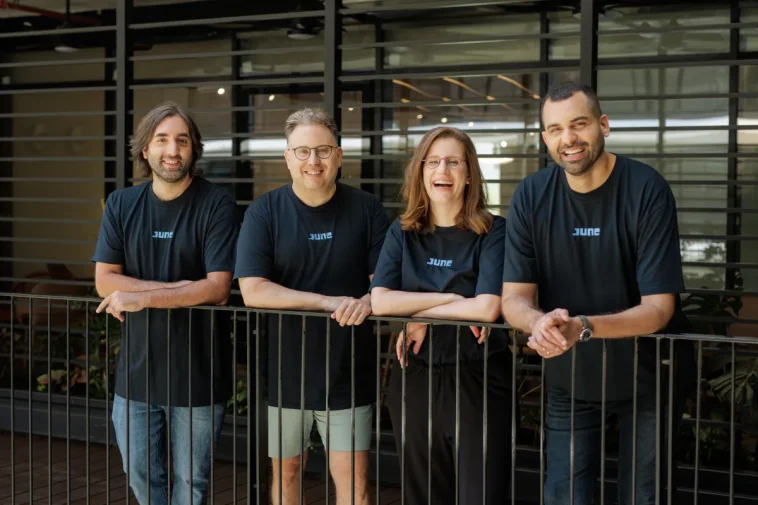
June, a company recently emerging from stealth, offers a transformative alternative to this labor-intensive approach. Led by Rapoport and her co-founders Ohad Hen, Barak Goldstein, and Idan Tsitiat, June is pioneering a platform designed to automate the integration of AI into existing enterprise environments. Their innovative concept resonated strongly with investors, securing $20 million in pre-seed funding. The round was notably led by Marc Benioff’s Time Ventures, with additional high-profile backing from tech luminaries such as Michael Dell, Aaron Levie, and George Kurtz, signaling significant industry confidence in June’s disruptive potential.
The founding team brings a wealth of relevant experience. They previously launched Bonobo AI, a pioneering pre-transformer language model company that delivered a voice-to-text service in 2017. Bonobo AI was subsequently acquired by Salesforce two years later, where the team dedicated several years to advancing the tech giant’s AI initiatives. This deep immersion in both AI development and enterprise customer needs provided a unique vantage point, revealing the profound difficulties companies faced in deploying AI within their established platforms, ultimately inspiring their next venture with June.
The “SaaSpocalypse” and the Reality of Legacy Systems
While discussions around a “SaaSpocalypse” – the fear that AI might render existing software firms obsolete – circulate within the tech world, the practical reality for Fortune 500 companies is far more grounded. No AI model, however sophisticated, can operate in isolation. It must seamlessly interface with foundational data management platforms such as Salesforce, ServiceNow, DataBricks, and Workday. This intricate web of interconnected systems represents the true frontier for AI adoption.
Rapoport succinctly articulates the core challenge: “Before AI can create value, someone has to deal with legacy systems.” Enterprises are burdened by fragmented data spread across disparate platforms, convoluted workflows, and years of accumulated technical debt. Building a rudimentary AI agent template might be straightforward, she explains, but getting it to function effectively within this messy reality is the critical hurdle. “How does an agent know how to operate when you have 10 duplicate [database] fields that say the same thing, and different teams are using them?” she asks, highlighting the common pitfalls of inconsistent data governance.
June’s Automated Solution for Enterprise AI Deployment
June’s platform addresses these pervasive issues head-on. It intelligently scans a company’s existing systems to meticulously map business processes, identify critical bottlenecks, and then construct optimized, agent-powered processes to replace them. The system even automatically notifies relevant teams through their established communication channels.
“We give you the full roadmap automatically of what needs to happen step by step for you to actually implement this agent successfully in an enterprise environment, which is often very complex,” Rapoport elaborates. This prescriptive guidance includes actionable steps like “Remove these duplicates. Connect to this data source.” Users can then simply click “build” on each task, and June commences the automated construction within the organization. This capability dramatically simplifies and accelerates a process traditionally requiring extensive manual analysis and intervention.
A Case Study in Efficiency: CMG Mortgage Lender
The practical impact of June’s approach is evident in early adopters like CMG, a prominent U.S. mortgage lender. Paul Akinmade, CMG’s chief strategy officer, had successfully migrated his company’s software engineering to Claude Code but encountered significant roadblocks when attempting to integrate it with Salesforce. This presented a considerable challenge, particularly after he had publicly committed to deploying 100 AI agents at a Salesforce conference the previous year.
Akinmade’s team spent weeks in a holding pattern, engaging with architects, FDEs, and various consultants, yet made little progress. June provided the breakthrough, offering his team a clear, actionable roadmap for agent deployment and enabling them to safely implement solutions even before a formal partnership kickoff. This experience underscores the profound frustration many enterprises face with traditional integration methods and highlights the urgent need for more streamlined, automated solutions.
Shifting the Paradigm: From FDEs to Automated Intelligence
While Efrat Rapoport views June as a complementary tool that can enhance the work of FDEs and consultants, its appeal to customers often lies in its potential to bypass such external dependencies entirely. Akinmade’s sentiment perfectly encapsulates this desire for self-sufficiency: “If your product requires FDEs, I don’t want your product. I’ve already… done that and I’m getting annoyed by it. I don’t want a black box. I don’t want something only certain people can figure out. I want an easy-to-use tool.”
June’s success in clearing this demanding bar signals a significant paradigm shift in enterprise AI adoption. By automating the arduous process of integrating AI into complex legacy systems, June empowers organizations to democratize AI deployment, making it accessible and manageable for internal teams. This approach promises to accelerate the time-to-value for AI initiatives, reduce reliance on costly external expertise, and ultimately unlock the transformative potential of artificial intelligence across a broader spectrum of industries, moving beyond the current bottlenecks of human-intensive integration.
#TrendingNow #ExplorePage #ViralContent #InstaDaily #CreatorEconomy #MotivationMonday #TechTrends #FitnessGoals #TravelGram #FoodieAdventures #FashionForward #DigitalMarketing
Artificial Intelligence, Cloud, Cybersecurity