Beyond the Grid: A Deep Dive into High-Performance Portable Power Stations
In an era where reliable power is paramount, whether for off-grid adventures, critical home backup, or professional field operations, portable power stations have become indispensable tools. As a senior tech journalist at InnovationWarrior.com, I’ve rigorously tested a diverse array of these robust energy solutions, pushing their limits to uncover their true capabilities and identify the innovations shaping their future. This comprehensive analysis delves into several notable contenders, offering insights into their performance, design philosophies, and broader implications for consumer and professional power needs.
Comprehensive Evaluations: Power Stations Under Scrutiny
Jackery Portable Power Station Explorer 2000 Plus
The Jackery Explorer 2000 Plus once held a top spot in our recommendations, and its enduring appeal remains for those seeking versatility and reliability. With a substantial 2,042-watt-hour capacity, its primary advantage lies in its expandability, allowing users to significantly boost power reserves through additional battery packs. This modularity is a critical feature, catering to escalating demands for extended runtime in diverse scenarios, from prolonged power outages to multi-day outdoor expeditions.
Our testing confirmed Jackery’s capacity claims, with the unit effortlessly handling high-wattage appliances like a UK kettle (3,000 watts), albeit consuming a noticeable 6 percent of its charge. Rapid AC charging is a strong point, complemented by efficient solar charging capabilities; a single SolarSaga 200-watt panel replenished 32 percent on a sunny day. While its 62-pound weight and sometimes finicky port covers present minor ergonomic challenges, the Explorer 2000 Plus stands as a formidable choice for robust home backup or dedicated off-grid power generation, backed by an extendable three-to-five-year warranty.
Bluetti Elite 200 V2
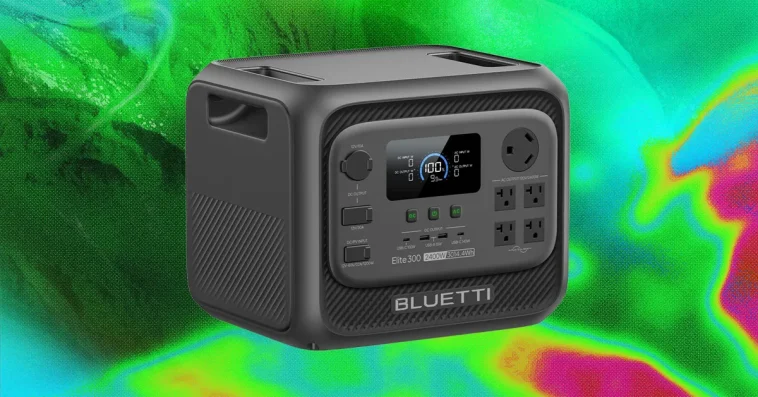
Positioned as a strong alternative to the slightly more powerful Elite 300, the Bluetti Elite 200 V2 delivers a solid 2,074-watt-hour capacity within a robust, well-engineered chassis. It maintains excellent build quality and a comprehensive feature set, including a 2,600-watt continuous output (with 3,900-watt peak surge) and a rapid 15-millisecond UPS delay. This makes it highly capable for sensitive electronics and critical applications where instantaneous power transfer is essential.
Its quick charging and intuitive, outdoor-legible display further enhance its usability, making it a compelling option for users who prioritize a balance of power and a more compact footprint than its larger sibling. The Elite 200 V2 underscores Bluetti’s commitment to delivering high-performance solutions across various capacity points, catering to a broad spectrum of portable power requirements.
BioLite BaseCharge 1500
The BioLite BaseCharge 1500, weighing 29 pounds, offers a more manageable form factor for transport, featuring recessed handles designed for easier carrying over shorter distances. Its minimalist design, devoid of a superfluous app, relies on straightforward physical buttons and a clear front display for all functions. This simplicity can be a significant advantage for users who prefer direct control over complex digital interfaces.
While adept at powering a variety of small gadgets and handling tools like electric drills and blenders, its 1,500-watt-hour capacity is better suited for less demanding tasks. A notable consideration is its Li-NMC battery chemistry, which, while offering good energy density, typically yields fewer charge cycles than LiFePO4 alternatives, potentially impacting long-term durability. The lengthy charging times, especially via a single 100-watt solar panel, highlight a trade-off for its portability and simpler interface, limiting its utility for rapid replenishment in dynamic environments.
Ampace Andes 600 Pro
The Ampace Andes 600 Pro presents itself as a highly portable solution, weighing in at a mere 19 pounds with a convenient top-carry handle. Its 584-watt-hour capacity and 600-watt continuous output (with an 1,800-watt surge) are tailored for smaller-scale power needs, making it ideal for camping trips, car travel, or powering a modest collection of personal electronics. The impressive one-hour full charge time in its 30 dB “sleep mode” is a significant advantage, minimizing downtime.
Equipped with a diverse array of ports and a remote-control app, the Andes 600 Pro offers good connectivity and smart features for its class. However, in a competitive landscape, its overall power output and capacity are outmatched by rivals like the EcoFlow River 2 Pro, which delivers more power for a lower cost, suggesting the Andes 600 Pro might be a niche choice for those prioritizing ultra-fast charging in a compact, lower-power package.
EcoFlow Delta 3 Plus
EcoFlow’s Delta 3 Plus impresses with its sleek, compact design and a comprehensive port layout, providing 1,024 watt-hours of power with a consistent 1,800-watt output and a 2,600-watt surge mode. Its ability to charge fully in an hour and its support for expandable capacity via stackable add-on batteries highlight its technical prowess. The inclusion of two solar ports for accelerated charging and an exceptional 10-millisecond UPS response time are premium features that appeal to users requiring seamless power transitions for sensitive equipment.
However, the persistent and often loud fan noise, even under minimal load, presents a significant user experience drawback. While a quiet charging mode exists, it drastically reduces the charging speed, forcing a compromise between rapid replenishment and a peaceful environment. This constant fan activity raises questions about thermal management and potential long-term component strain, issues that EcoFlow will need to address to fully capitalize on an otherwise highly capable and feature-rich power station.
Bluetti AC200L
The Bluetti AC200L, while now superseded by the Elite 200 V2, remains a respectable contender in the portable power station market. Offering a slightly lower capacity than its successor, it nonetheless provides a solid foundation with similar core features and the valuable ability to expand up to 8,192 watt-hours with Bluetti’s modular batteries. Its design and performance largely mirror the Elite 200 V2, affirming Bluetti’s consistent engineering.
Despite being marginally heavier and currently less competitively priced than newer models, the AC200L still represents a viable option for consumers seeking robust, expandable power. Its continued presence in the market underscores the rapid evolution of this technology, where newer iterations often deliver enhanced performance or greater value, prompting discerning buyers to carefully compare specifications and pricing against the latest offerings.
Dabbsson DBS1000 Pro Portable Power Station
The Dabbsson DBS1000 Pro, with its 1,024-watt-hour LiFePO4 battery, offers a robust set of features, including a strong 2,000-watt output (with 3,000-watt boost and 4,000-watt surge modes) and fast charging capabilities to 80 percent in under an hour. Its comprehensive port selection and EPS functionality with a 15-millisecond delay make it a versatile unit for both everyday use and emergency situations. The customizable underglow light adds a unique aesthetic touch, and the app-controlled features provide modern convenience.
However, the DBS1000 Pro is not without its issues; frequent and noticeable fan noise, along with an observed intermittent USB charging fault, detract from an otherwise capable device. While expansion options exist to increase capacity and output, these minor reliability and user experience concerns prevent it from truly distinguishing itself in a crowded market. The five-year warranty, however, offers a substantial peace of mind.
Bluetti AC180
For users whose power demands are more modest, the Bluetti AC180 provides a compelling, if somewhat weighty, solution. Featuring a 1,152-watt-hour LiFePO4 battery, it delivers a steady 1,800 watts (with a 2,700-watt surge) and includes a comprehensive selection of AC, USB-C (100W), and USB-A ports, alongside a convenient wireless charging pad. Its ability to fully charge from a wall outlet in just an hour, coupled with solar and car charging options, ensures versatile replenishment.
The AC180’s 20-millisecond UPS switching time makes it suitable for running small appliances like TVs or mini-fridges during outages. While its 35-pound weight feels relatively substantial for its capacity, and the preference for more USB-C ports is a modern consideration, its solid performance and reliable LiFePO4 battery chemistry make it a strong contender for those prioritizing durability and efficient power for essential devices.
Zendure SuperBase Pro 2000
The Zendure SuperBase Pro 2000 is a powerhouse, boasting an impressive 2,096-watt-hour capacity and a maximum output of 2,000 watts (3,000-watt surge), supported by an extensive array of outlets. Its portability is enhanced by integrated wheels and a telescopic handle, making its 47-pound frame more manageable. The intuitive Zendure app and reliable uninterruptible power supply (UPS) functionality further elevate its appeal.
A critical design choice here is the Li-NMC battery, which, while providing excellent energy density for its size, inherently offers a shorter lifespan compared to LiFePO4 cells. This trade-off between power-to-size ratio and cycle longevity is a key consideration for prospective buyers. The persistent fan operation, while indicative of efficient thermal management for the Li-NMC chemistry, can be a nuisance in quiet environments. Zendure’s exploration of semi-solid-state batteries in its premium offerings, promising enhanced stability and density, hints at future advancements that could mitigate some of these compromises.
Portable Power Stations to Approach with Caution
Acer 600W Portable Power Station
The Acer 600W Portable Power Station offers a compact design with a 512-watt-hour LiFePO4 battery and a good selection of nine ports, making it suitable for basic campsite needs like lighting and charging small gadgets. Its ability to fully charge in approximately two hours from a wall outlet is commendable for its capacity. The clear LCD provides essential information on battery status and power flow.
However, its restricted availability, primarily in the UK, significantly limits its market reach. More critically, its price point for the given capacity and a modest 600-watt maximum output position it unfavorably against more powerful and cost-effective alternatives available globally. For consumers, this translates to a less competitive value proposition, especially when higher-capacity, similarly priced units offer greater versatility.
Vtoman FlashSpeed Pro 3600
The Vtoman FlashSpeed Pro 3600 represents a cautionary tale in portable power station design. While it attempts to address its substantial size and weight (3,096 watt-hours) with wheels and a telescopic handle, fundamental flaws undermine its utility. An initial faulty unit, followed by a replacement that still underperformed, points to potential quality control issues within the manufacturing process.
Beyond reliability concerns, practical design oversights, such as an impractical plastic front panel obstructing port access and an outdoor-illegible display, severely hamper user experience. The questionable build quality, characterized by creaky components, further detracts from its professional appeal. Despite its impressive sustained 3,600-watt output and peak surges exceeding 7,000 watts, its overall unwieldy size and numerous functional shortcomings render it a less desirable option compared to more refined and dependable power stations like the Bluetti Elite 300.
The Evolving Landscape of Portable Power
The portable power station market is rapidly innovating, driven by advancements in battery technology, the increasing demand for energy independence, and a growing emphasis on smart, user-friendly features. As we move forward, expect to see further refinements in battery chemistry, with semi-solid-state and other next-generation cells offering improved energy density, safety, and cycle life. Charging speeds will continue to accelerate, alongside more efficient solar integration.
Connectivity and smart management will also become standard, enabling users to monitor and control their power stations remotely with greater precision. The trend towards modular, expandable systems like the Jackery Explorer 2000 Plus will persist, providing scalable solutions for diverse needs. Ultimately, the future promises portable power solutions that are lighter, more durable, faster to charge, and seamlessly integrated into our increasingly electrified lives, redefining what it means to be truly “off-grid” or prepared for any power eventuality.
#Engagement #SocialMediaTips #ContentMarketing #DigitalStrategy #AudienceGrowth #CommunityBuilding #TrendAlert #ViralContent #MarketingTips #SuccessMindset #OnlinePresence #BrandAwareness
Artificial Intelligence, Generative AI, Cloud