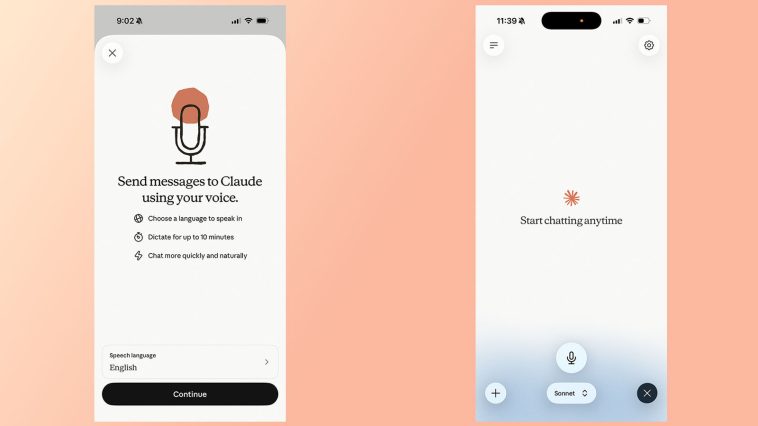
Anthropic Unleashes Enhanced Conversational Power with Advanced Claude Voice Mode
In a significant leap forward for conversational AI, Anthropic has dramatically upgraded its Claude chatbot’s voice capabilities, offering users a more robust and versatile way to interact. Since its initial rollout in 2025, the voice mode has been a compelling feature, enabling natural language spoken input rather than typed prompts. The recent July 2026 update, however, transforms this interaction from a mere convenience into a powerful new dimension of AI engagement.
This expansion signifies Anthropic’s commitment to making AI more accessible and intuitive. By moving beyond text-based interactions, the company is catering to a broader range of user preferences and use cases, from hands-free operation to more natural, spontaneous brainstorming sessions. The implications for productivity and user experience are substantial, positioning Claude as a more dynamic digital assistant.
Enhanced Conversational AI: Claude’s Voice Mode Evolution
The core of this update lies in the expanded model support for voice interactions. Previously, users were limited to Haiku, Anthropic’s fastest but least powerful model, a design choice made to minimize latency. Now, Claude’s more sophisticated models, including Sonnet and the flagship Opus, are fully integrated into the voice mode, unlocking a new level of intelligence and contextual understanding for spoken queries.
This strategic move directly addresses a critical demand for advanced AI capabilities in spoken interfaces. Users can now leverage Opus’s profound reasoning and complex task execution through voice, alongside Sonnet’s efficiency for everyday tasks. The ability to pull context from connected apps and services further elevates Claude’s utility, transforming it into a proactive and integrated digital assistant that understands more than just your words.
Navigating Claude’s Voice Interface
Accessing Claude’s enhanced voice mode is straightforward across its various platforms. The feature is available on both the Claude mobile apps (Android and iOS) and the desktop application, as well as via the web interface. Anthropic explicitly highlights that the optimal experience is typically found on mobile devices, where hands-free interaction can be particularly beneficial.
To initiate a voice conversation on a mobile device, users simply open the Claude app and tap the distinct black waveform icon located in the lower right corner. After granting the necessary microphone permissions, users can begin speaking their prompts. Claude processes the input and generates a response once the prompt is complete, remaining in voice mode until manually stopped.
Architectural Distinctions: Turn-Based vs. Duplex
It’s crucial to understand the underlying architecture of Claude’s voice mode, which operates on a “turn-based” system. This means the chatbot listens to a complete user prompt before processing and generating its response. This approach, while effective, differs from the “duplex” architecture recently adopted by competitors like ChatGPT, which allows simultaneous speech processing and output generation.
The turn-based nature occasionally means Claude might interpret a brief pause as the end of a query, leading to premature responses. Anthropic, therefore, advises users to break down multi-part questions into individual prompts for optimal clarity and accuracy. This distinction highlights an ongoing frontier in conversational AI development, balancing immediacy with comprehensive understanding, and suggests potential future evolutions for Claude’s voice interaction model.
Optimizing Model Selection for Your Needs
A significant benefit of the updated voice mode is the flexibility to select the most appropriate AI model for any given task. Users can easily switch between models using the picker at the bottom of the interface, tailoring Claude’s intelligence to their specific requirements. This control empowers users to optimize both speed and complexity.
- Haiku: Best suited for quick questions and rapid responses, offering minimal latency.
- Sonnet: The go-to for daily tasks and general productivity, balancing speed with higher intelligence.
- Opus: Reserved for the most complex problem-solving and intricate reasoning, available exclusively to paid subscribers.
This tiered approach ensures that users, whether engaging in casual queries or complex analytical tasks, have access to the right level of AI power directly through voice. The ability to route voice prompts to Opus, Anthropic’s most capable model, is a game-changer for professionals seeking advanced assistance on the go.
Seamless Integration with Your Digital Ecosystem
Beyond its core conversational abilities, Claude’s voice mode seamlessly integrates with your connected applications and services. Just as with text chat, spoken prompts can leverage access to platforms like Gmail, Google Calendar, and Slack. This capability transforms Claude into a true personal assistant, capable of acting on information across your digital life.
Imagine asking Claude to “summarize my unread emails from yesterday” or “schedule a meeting with John for next Tuesday afternoon” — all through natural voice commands. This level of integration streamlines workflows and enhances productivity, allowing users to interact with their digital ecosystem in a more intuitive, hands-free manner. First-time access to a third-party app will, of course, require user permission for security and privacy.
Global Reach: Customizing Voice and Language
Anthropic has also made significant strides in globalizing Claude’s voice capabilities, with support for 14 different languages as of July 2026, many of which include additional dialects. This commitment to linguistic diversity underscores the ambition to make advanced AI accessible to a worldwide audience, fostering truly inclusive technological advancement.
The chosen language directly influences the available voice options. For instance, English speakers can select from five distinct voices – Buttery, Airy, Mellow, Glassy, and Rounded – along with adjustable cadences (Slow, Normal, Fast). While other languages might have fewer options, the breadth of support is commendable. A current limitation, however, is Claude’s inability to detect spontaneous language switching mid-sentence; users are advised to state their intent to switch languages or adjust settings proactively.
Subscription Tiers and Accessibility
Accessibility remains a cornerstone of Anthropic’s strategy, with Claude Voice available to all users, regardless of subscription status. However, free accounts are limited to interaction with the Haiku and Sonnet models. For most everyday tasks, Sonnet provides ample intelligence, offering a robust voice experience without a premium subscription.
For those requiring the profound analytical capabilities of the Opus model, a paid Pro or Max subscription is necessary. It is also important to note that all voice mode conversations contribute towards a user’s overall usage limits. Furthermore, free accounts are currently restricted to a single connected app, although full language support remains universal across all tiers. This tiered access ensures a foundational experience for all, while offering advanced capabilities to power users.
#SocialMediaTips #DigitalMarketing #ContentCreation #OnlineBusiness #GrowthHacking #MarketingStrategy #EngagementBoost #BrandBuilding #EntrepreneurLife #SuccessMindset #InfluencerMarketing #CommunityBuilding
Artificial Intelligence, Cloud, Cybersecurity