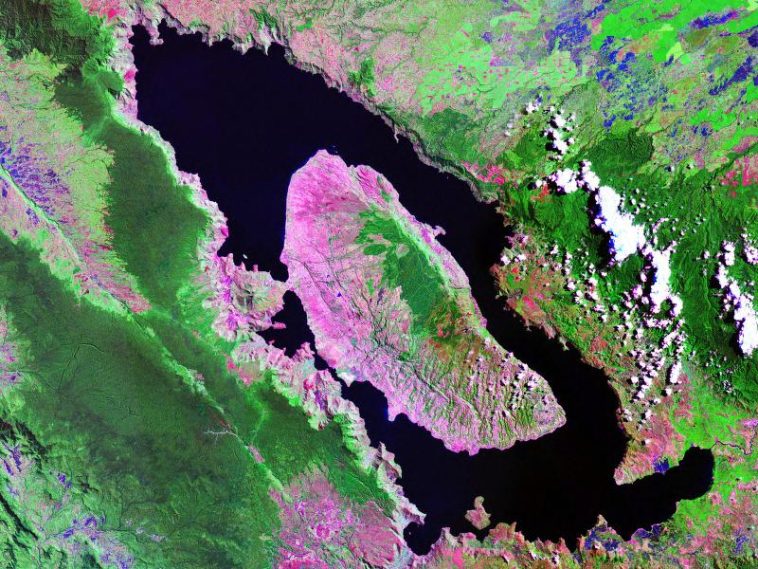
Re-evaluating Earth’s Most Catastrophic Eruption: The Mount Toba Event and Its Climate Riddle
San Francisco, CA – For decades, the colossal eruption of Mount Toba 74,000 years ago has loomed large in our understanding of Earth’s ancient past and even humanity’s very survival. This super-eruption, the largest known in the last 2.6 million years, unleashed an unimaginable volume of magma—thousands of cubic kilometers in just two weeks, dwarfing the 1991 Mount Pinatubo event by a factor of a thousand. It was widely theorized to have plunged the planet into a devastating “volcanic winter” that pushed our ancestors to the brink of extinction.
However, recent groundbreaking research is challenging this long-held catastrophic view, offering a nuanced perspective on the Toba event’s actual climatic impact. The findings suggest that while undoubtedly immense, Toba’s global cooling effects were far more limited in duration and magnitude than previously assumed. This revelation fundamentally reshapes our understanding of ancient climate dynamics and early human resilience.
Unearthing Climate Clues from Ancient Lakebeds
A team led by Jinheum Park, a geoscientist at Johannes Gutenberg University in Mainz, Germany, embarked on a quest to find direct evidence of Toba’s aftermath. Their investigation focused on meticulously analyzing mud samples extracted from the bottom of a small crater lake nestled on the Kenya-Tanzania border. These sediments act as natural archives, preserving a detailed chronological record of environmental conditions over millennia.
What they discovered contradicted the prevailing narrative. Instead of evidence for prolonged, severe cooling, the geological record indicated that the most significant effects of the Mount Toba eruption lasted for less than two years. The global temperature dip amounted to a modest half-degree Celsius. This localized and relatively short-lived impact paints a very different picture of post-Toba Earth.
The Physics of Volcanic Haze: A Counterintuitive Effect
The mechanism behind volcanic cooling is well-understood: explosive eruptions inject massive quantities of sulfur dioxide (SO2) into the stratosphere. There, SO2 transforms into a haze of tiny sulfate aerosols. These microscopic droplets efficiently reflect incoming sunlight back into space, leading to a cooling effect on the planet’s surface.
However, the new research highlights a critical, often overlooked aspect of this process: the sheer scale of an eruption can paradoxically limit its long-term cooling potential. As Park explains, the “bigger eruption, more cooling” trend has a threshold. Extremely large sulfate aerosols, formed during super-eruptions like Toba, are simply too heavy. This increased mass causes them to settle out of the stratosphere more rapidly, significantly reducing their effectiveness in scattering solar radiation over extended periods.
Future Implications for Climate Science and Humanity
These findings have profound implications, not just for reconstructing ancient climates but also for modern climate science and our understanding of human adaptability. It forces a re-evaluation of how super-volcanic events are modeled and their potential for global impact. The idea that larger aerosols settle quicker suggests a built-in feedback loop that might temper the most extreme “volcanic winter” scenarios, even from colossal eruptions.
Furthermore, this research offers a more optimistic perspective on humanity’s ability to withstand major environmental cataclysms. While the Toba eruption was undoubtedly a regional disaster, the limited global climate impact suggests that early human populations, particularly those in resilient refugia, may not have faced the uniform, species-threatening bottleneck once envisioned. Understanding such resilience is crucial as we grapple with future climate challenges.
This new chapter in the Toba story underscores the continuous evolution of scientific understanding and the power of high-resolution paleoclimate data. It reminds us that Earth’s systems are complex, and even the most seemingly straightforward relationships, like volcanic output and global cooling, can harbor surprising nuances. The long shadow of Toba may be shrinking, but its lessons on planetary dynamics and human endurance continue to grow.
#TrendingNow #Innovation #FutureOfTech #AI #Gaming #HealthAndWellness #Travel #Fashion #Sustainability #DigitalMarketing #PersonalDevelopment #WorldNews
Artificial Intelligence, Cloud, Cybersecurity