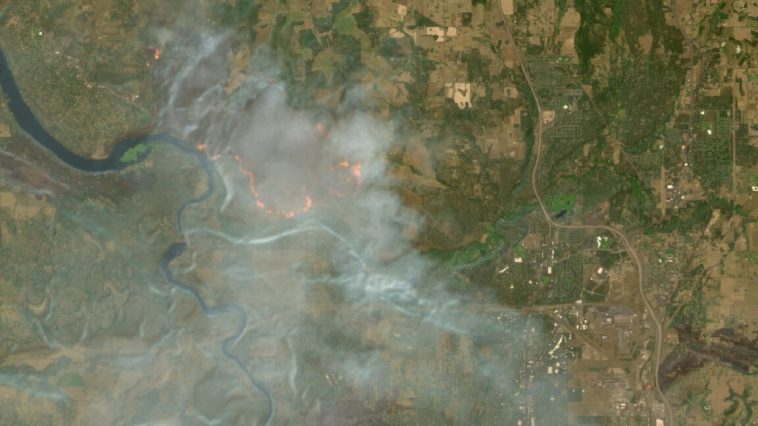
Combating the Blaze: A New Era of Wildfire Intelligence
The escalating global threat posed by wildfires demands ever more sophisticated and accessible tools for monitoring and response. In a significant leap forward, Europe’s free and open satellite imagery service now empowers anyone to track these devastating blazes with unprecedented ease, thanks to a powerful new visualization capability. This enhancement, built upon a foundational script nearly a decade in the making, marks a critical advancement in disaster monitoring.
Unlocking Earth’s Eye: The Copernicus Sentinel-2 Advantage
At the heart of this capability lies the Copernicus Browser, offering unfettered access to cutting-edge satellite imagery from the European Space Agency’s Sentinel constellation. As a cornerstone of the European Union’s Earth observation program, the Sentinel missions provide invaluable data. Specifically, the three satellites comprising the Sentinel-2 mission are instrumental for wildfire monitoring, delivering high-resolution multi-spectral imaging.
Operating at a granular resolution of 10 meters, Sentinel-2 captures data across both visible light and crucial near-infrared bands. This spectral diversity is vital, allowing experts to differentiate between active flames, smoldering vegetation, and already scorched earth. Previously, the Copernicus Browser offered ten distinct default visualization layers, each utilizing various combinations of these spectral bands for different analytical purposes.
Instant Insights: The Wildfire Visualization Layer
Building on this robust foundation, the Copernicus Browser officially launched a streamlined “wildfires” visualization layer for Sentinel-2 imagery on August 4. This user-friendly addition radically simplifies the process of identifying fire activity. Users can now click on this specific layer when viewing a wildfire-affected region and instantly discern critical information.
Active fires are clearly depicted in vivid white or yellow, providing immediate indication of ongoing combustion. Burning vegetation appears in stark red, highlighting areas under imminent threat or actively consumed by flames. Furthermore, previously burned landscapes are rendered in dark brown or black, offering a clear demarcation of the fire’s historical path and overall impact. This intuitive visualization democratizes access to critical geospatial intelligence for a broad audience, from emergency services to concerned citizens.
Beyond Tracking: Strategic Insights and Future Resilience
The integration of this dedicated wildfire layer is more than just a convenience; it represents a strategic enhancement in global disaster preparedness and environmental stewardship. The instantaneous and accessible nature of this data empowers emergency responders with real-time intelligence, facilitating more effective resource deployment and evacuation planning. For researchers, it provides a wealth of information for studying fire behavior, assessing climate change impacts, and refining predictive models.
Looking ahead, this accessibility could spur further innovation, including integration with AI-driven analytics for early detection and spread prediction. The ongoing commitment to open data through initiatives like Copernicus fosters a collaborative environment, driving advancements that will be increasingly vital as global temperatures rise and wildfire events intensify. This development underscores the critical role of space-based technology in building a more resilient future against natural hazards.
#TrendingNow #Innovation #TechNews #Motivation #DailyInspiration #TravelGram #Foodie #FitnessGoals #Mindfulness #SustainableLiving #ArtAndDesign #BookLover
Artificial Intelligence, Generative AI, Cloud
The search results confirm the high relevance of “Artificial Intelligence” (AI), “Generative AI” (GenAI), and “Cloud” computing in the current and near-future technology landscape (2026).
Artificial Intelligence is consistently highlighted as a major buzzword and a deeply integrated, transformative technology impacting various sectors like healthcare, finance, and education, and driving economic growth and innovation. Generative AI is identified as a significant breakthrough within AI, capable of creating new content and transforming how machines interact with humans, with its rapid evolution and potential to boost productivity and global GDP. Cloud computing is described as essential for scalable, cost-effective, and flexible data solutions, enabling rapid application development, deployment, and fostering innovation. These three keywords represent foundational, transformative, and pervasive aspects of modern technology.