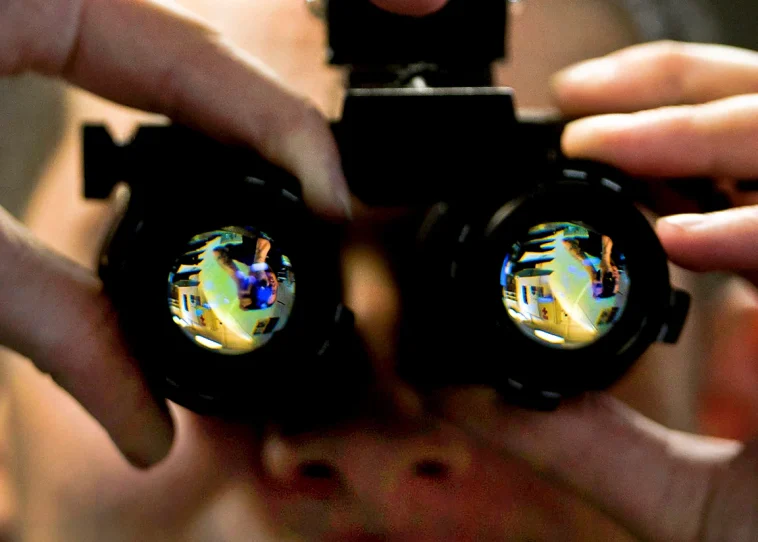
A New Dawn for Night Vision: Beyond the Monochromatic Green
For decades, the world has viewed the nocturnal realm through the same hazy, monochromatic green lens of traditional night-vision technology. This familiar yet limiting paradigm, characterized by grainy images and poor depth perception, has remained largely unchanged, creating significant challenges for tasks requiring precise object discrimination. However, a groundbreaking development from researchers at the Beijing Institute of Technology promises to shatter this status quo, introducing a system that translates infrared light into vivid, discernible color images.
The Limitations of Legacy Systems
Conventional night-vision goggles operate by amplifying the scarce ambient light available and converting it into a single, green-hued image, where information is conveyed solely through variations in brightness. While functional, this approach is fundamentally misaligned with human visual perception. Our eyes are exquisitely tuned to differentiate between millions of color shades, a capability far superior to our ability to discern subtle gradations of brightness in a monochrome field. This mismatch has historically hindered situational awareness and the accurate identification of threats or intricate details in low-light environments.
Unveiling the Color Spectrum of Darkness
The innovative device developed by the Beijing Institute of Technology directly addresses these shortcomings. Their system masterfully translates specific infrared wavelengths into distinct color variations, effectively redefining infrared vision. As the researchers articulate in their paper published in Science Advances, they “redefine infrared vision by transcending the monochrome paradigm, translating infrared spectral and intensity signatures into discernible color variations rather than mere brightness changes.” This fundamental shift moves beyond mere light amplification, offering a richer, more intuitive visual experience.
The Quantum Leap in Conversion Technology
At the heart of this transformative technology is a prototype upconverter, an incredibly thin stack of films layered onto a glass slide, mere hundreds of nanometers thick. The core component is a film of mercury telluride quantum dots. These minuscule semiconductor crystals, each less than four nanometers across, harness novel quantum mechanical effects to detect even the faintest amounts of infrared radiation.
Directly above this sophisticated detection layer sits a specially designed Organic Light-Emitting Diode (OLED) display, reminiscent of those found in modern smartphones. Unlike standard displays, this one features two distinct light-emitting layers. A lower layer glows red in response to relatively low levels of charge from the detector, while an upper, cyan-emitting layer requires a significantly stronger electrical flow to activate. This ingenious dual-layer design is key to the system’s color-rendering capabilities.
Intelligent Color Mapping for Enhanced Perception
The brilliance of this design lies in its ability to translate both the intensity and wavelength of infrared signals into a dynamic color display. A weak infrared signal will predominantly activate the red layer. As the signal strengthens, it begins to stimulate the cyan layer, causing the image to brighten and shift its color as red and cyan light mix. This process is driven by the quantum dots, which release more charge not only when the infrared radiation is brighter but also when the wavelength is shorter, as shorter wavelength photons carry greater energy.
This sophisticated mapping means the color perceived on the display directly correlates with both the strength of the infrared signal and its approximate wavelength. The team’s calculations reveal a remarkable improvement in human perception: individuals could discern infrared power differences of 0.11 milliwatts per square centimeter using both color and brightness cues, a staggering 200-fold enhancement compared to relying solely on brightness, which yielded a detection threshold of 23.71 milliwatts per square centimeter. This dramatic improvement in sensitivity and information density marks a significant leap forward in visual acuity under challenging conditions.
Demonstrating Real-World Potential
To underscore the practical applicability of their innovation, the researchers ingeniously integrated the upconverter into a pair of spectacle frames. When exposed to infrared light, the prototype lens demonstrated a clear progression of color, shifting from deep red to orange and then yellow as the illumination intensified. Furthermore, the system successfully rendered intricate patterns, such as letters, and adeptly tracked moving and rotating targets.
Beyond external vision aids, the team also explored the potential for augmenting natural vision itself. In a compelling experiment, neurons were engineered to produce channelrhodopsin-2, a protein known to stimulate nerve cells when exposed to blue light. The upconverter was then bound to these engineered neurons. When infrared light struck the system, the device emitted blue light powerful enough to trigger these proteins and stimulate the neurons, with electrical recordings confirming stronger currents inside the cells as the infrared signal intensified. This groundbreaking demonstration suggests possibilities extending beyond traditional eyewear.
Finally, in a testament to the technology’s potential for direct biological interaction, the team taped upconverters over the eyes of mice and humans. While infrared pulses alone yielded no reaction, the presence of the device provoked strong electrical responses in the brains of mice and the retinas of humans. These early-stage biological integration experiments hint at a future where our sensory capabilities could be fundamentally expanded.
The Path Forward: From Lab to Ubiquitous Application
While the demonstrations thus far have occurred in controlled laboratory environments, and the current prototype requires an external power source for its OLED display and an infrared illuminator, the implications of this technology are profound. This pioneering step paves the way for a new generation of night-vision systems that could revolutionize various sectors.
Imagine law enforcement and military personnel operating with unprecedented clarity in total darkness, discerning intricate details and subtle thermal signatures previously invisible. The automotive industry could integrate these systems for vastly improved nighttime driving safety, providing drivers with richer, colorized views of their surroundings. Furthermore, medical imaging could see advancements, potentially allowing doctors to visualize subsurface tissues with greater detail and accuracy. While significant engineering challenges remain in miniaturization, power efficiency, and robust integration, the foundational research from the Beijing Institute of Technology has undeniably opened the door to a more vibrant, informed, and secure nocturnal world. The era of grainy green night vision is poised to become a relic of the past.
#TrendingNow #ViralContent #ExplorePage #ForYou #InstaDaily #SocialMedia #Engagement #DigitalMarketing #ContentCreator #Community #Interaction #MustSee
Artificial Intelligence, Cloud, Cybersecurity