Dr. Santanu Paul is founder and CEO of TalentSprint.
getty
ChatGPT has once again stirred the hornet’s nest on whether intelligent machines can outcompete and supersede humans in most spheres of human activity and, in time, become sentient. Although this is a deep speculative question in the realm of philosophy, one thing is already abundantly clear in the real world: Modern intelligent machines are making it possible for skilled human experts to perform superhuman feats on a daily basis.
I began my journey with intelligent machines as a young computer scientist at the IBM T.J. Watson Research Center in Yorktown Heights, New York. It was there that I had the privilege of watching Deep Blue, the AI-powered chess machine, challenge and defeat Gary Kasparov, the reigning world champion, in 1997.
Between 2016 and 2021, I was fortunate to serve as a board director and chair of the Innovation Council at NPCI, a fintech giant that processes over eight billion digital payment transactions each month using a protocol called unified payment interface (UPI). The transformational impact of this citizen-scale platform (paywall) on India was recently covered by the New York Times. During my tenure, I bore witness to the evolution of complex AI software to automate the detection of fraudulent transactions in real time.
As an edtech founder and CEO, I have been deeply interested and involved in the design and deployment of AI tutor bots for over a decade. The vision we have is for these personal tutor bots to take significant teaching load off of human instructors and automate the mechanisms of assessing, upskilling and coaching very large student populations on a one-to-one basis.
What I have learned from these myriad experiences is that from playing chess to teaching classes, from performing surgery to fighting fires, and from flying planes to waging war, we are entering the era of cyborgs. Most dictionaries define a cyborg as a creature that is part human and part machine or as a living organism whose powers have been significantly amplified by hardware implants and embedded software. The term “cyborg” entered the lexicon and public consciousness in the 1960s with Darth Vader, the lead villain in the sci-fi movie Star Wars. And now cyborgs are everywhere.
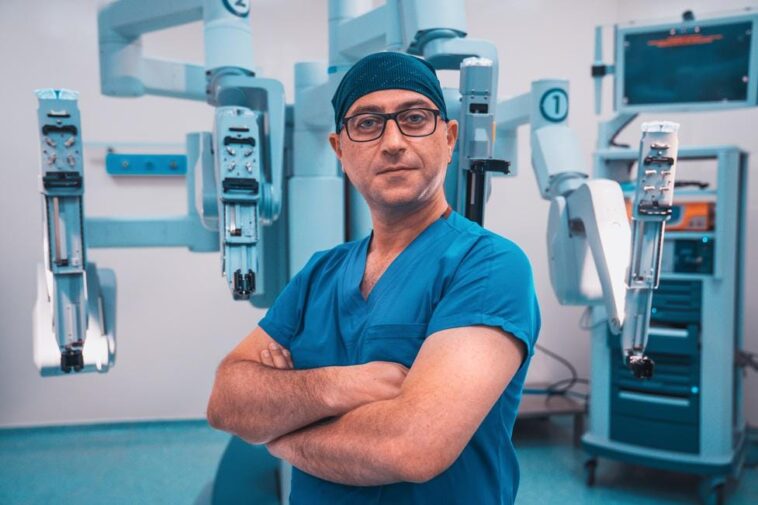
Consider medical robotics. Human surgeons assisted by surgical robots are delivering better patient outcomes, experiencing less burnout and extending their surgical careers by an extra decade. Surgical robots can move cameras by tracking the eyes of the human surgeon and provide haptic feedback on forces encountered by the robotic arm. Study results show that robot-assisted surgery reduces the probability of readmission by 52% and the formation of blood clots (which, according to researchers, is “a significant cause of health decline and morbidity”) by a “striking” 77% compared to patients who undergo open surgery.
That said, the fact remains that only about 15% of global surgical procedures currently involve robots. However, according to Verified Market Research, the global robot-assisted surgery market, valued at $6.1 billion in 2020, is expected to reach $22.27 billion by 2028. As these kinds of robots become smarter and more affordable, I believe that robot-assisted surgeries are going to be the norm, not the exception, in the future.
If surgery is an esoteric use case, consider firefighting. In the near future, we may see firefighters wear purpose-built exoskeletons outfitted with specialized tools to confront intractable fires. An exoskeleton prototype developed by Chinese scientists weighs only 11 pounds and “can save more than 50% of the energy humans expend in walking, climbing and carrying objects.” The expectation is that inbuilt sensors and intelligence in such exoskeletons will help turn firefighters into superheroes who can see through smoke-filled environments, map and navigate surroundings, communicate with colleagues and commanders and rescue victims quickly under hostile conditions.
Although commercialization is a work in progress, the market for cyborg-style exoskeletons, in general, is poised to make a big impact. Global revenues are expected to “reach more than $7 billion in this emerging market, with industrial use cases being a major catalyst.”
What is true on land is true in the air. Combat pilots are considered hyper-professionals, and the penalty for even a small error can be death. Keeping pilots safe and combat-ready is a major priority for flying squadrons. AI-powered training systems can digest vast amounts of instrumentation data from every flight and auto-generate personalized training plans for every pilot.
“What air speed you execute an approach and a landing in a Strike Eagle [an F-15E] is dependent on your fuel weight,” explains Major Mark Poppler of the fourth F-15 training squadron of the U.S. Air Force. “And so [the AI tool] can actually calculate final approach speed based on your fuel weight. And then grade you to the same standards that an evaluator pilot would grade you: Was your approach on speed? Did you touchdown fast? Did you touchdown in the appropriate portion of the runway?”
Developing an individual combat pilot using human instructors and traditional methods can cost millions of dollars and take many years. Today, AI-powered training systems can step in as personalized flight instructors to continually upskill pilots and also keep them safe in the air.
Each of these human-machine collaboration examples sheds light on the enormous potential of collaborative intelligence. A surgeon partnering with a smart robot, a firefighter wearing an intelligent exoskeleton and a combat pilot continuously learning under the watchful eye of AI-powered software are just a few examples of how professionals with specialized expertise can amplify their capabilities much further when assisted by machines.
This is true for not just left-brained structured work but also right-brained creative work. We are already witnessing how AI is amplifying human capabilities in sports, music, art and design. So, perhaps the future of human expertise is not to try and compete with AI but to master the ability to coexist and collaborate with it.
Forbes Technology Council is an invitation-only community for world-class CIOs, CTOs and technology executives. Do I qualify?