America at 250: The Enduring Power of Collective Ambition
As the United States approaches its 250th anniversary, the nation stands at a pivotal juncture, grappling with internal divisions and rapidly evolving global dynamics. Yet, much like a seasoned enterprise, America’s fundamental brand—its core promise and collective ambition—remains a powerful force, constantly requiring renewal. The journey of a nation, akin to that of any enduring organization, hinges on its ability to consistently uphold the ideals it espouses and adapt to changing realities.
My own father, a man of humble beginnings who balanced multiple vocations from stacking fruit to preaching sermons, often observed a profound truth: both hourly work and spiritual leadership demand an unwavering commitment to something greater than the immediate task. They require showing up consistently, believing in an overarching purpose, and speaking truth about potential. This insight, drawn from the grassroots of American life, mirrors the enduring challenge and promise of the nation itself.
The Architecting of a National Brand
At 250 years old, the United States represents arguably the most ambitious and enduring brand ever conceived. Its longevity and influence are not accidental; they are a testament to the power of a foundational promise and the continuous, often arduous, work of fulfilling it. Like any great institution, its vitality is inextricably linked to how faithfully it practices what it preaches, both domestically and on the global stage.
Fifteen years ago, leadership scholars Doug Ready and Emily Truelove articulated the animating spirit of powerful brands as “collective ambition” in a seminal Harvard Business Review article. Their model delineates seven critical elements that enable great leaders to unify disparate individuals for the common good: purpose, vision, promise, values, targets, priorities, and the daily behavior of those who embody the brand. This framework, originally applied to corporate success, offers profound insights into the mechanics of national endurance. When these elements align, a nation thrives; when they diverge, the fabric of trust and cohesion begins to fray, impacting everything from civic engagement to economic productivity.
The Unfinished Blueprint of a More Perfect Union
Two and a half centuries ago, in the nascent days of the republic, a group of imperfect men in Philadelphia drafted the blueprint for a “more perfect Union.” They articulated a revolutionary promise: life, liberty, and the pursuit of happiness. By invoking “Nature’s God” and committing to values deemed worth dying for, they acknowledged the nation’s inherent imperfections from day one, yet simultaneously laid the groundwork for an aspirational future. They entrusted succeeding generations with the ongoing imperative to build and refine.
“Perfecting” is, fundamentally, a verb, not a static adjective. The Founders understood that national identity is not a fixed state but an ongoing process of evolution and self-correction. Their trust in us was a call to continuous construction, to perpetually strive for the ideals they enshrined. This dynamic view of nation-building stands in stark contrast to any notion of a finished product, inviting innovation and adaptation in every era.
A Tradition of Transformative Renewal
America’s history is punctuated by remarkable moments of renewal, serving as an inspiration to the world. These episodes often follow periods of profound crisis, mirroring ancient narratives of struggle preceding triumph.
Consider the turbulent years leading to the Constitution. In 1787, the Articles of Confederation teetered on the brink of collapse, exemplified by Shays’ Rebellion, revealing a government incapable of basic governance. It was the intellectual and persuasive prowess of Madison, Hamilton, and Jay, writing under the pseudonym Publius, who, through 85 essays, effectively “talked the country into” a new constitution. “We the People” began as a powerful narrative vision before manifesting as a written reality, demonstrating the power of shared belief to forge a new collective path.
Decades later, in the depths of the Great Depression, President Franklin D. Roosevelt’s swift policy actions were amplified by his iconic “fireside chats.” These direct, reassuring broadcasts fostered a renewed faith that government and capitalism could indeed serve ordinary citizens, not just powerful elites. His wife, Eleanor Roosevelt, extended this reach, traveling the nation as his eyes, ears, and conscience, building trust and understanding on the ground. This era highlighted the critical role of empathetic leadership and direct communication in restoring national confidence.
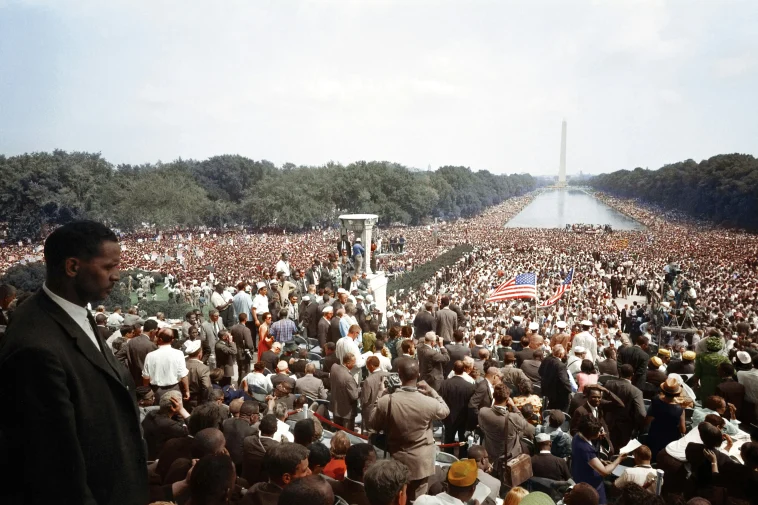
The 1960s witnessed another profound moral reckoning. Dr. Martin Luther King Jr., refusing to engage on terms of degradation, held America accountable to its own promissory note. Alongside his potent voice, the tireless efforts of women like Ella Baker, Fannie Lou Hamer, and Diane Nash provided the organizational bedrock of the Civil Rights Movement. Their grassroots activism, combined with President Lyndon Johnson’s courage in signing landmark legislation, ultimately redefined the nation’s commitment to equality. These historical figures collectively embodied the “collective ambition” needed to redefine national values and behavior.
The Fragility of Progress and the Cost of Division
Yet, history also serves as a potent reminder of progress’s inherent fragility. President Abraham Lincoln’s monumental renewal of the 1860s, which delivered the Gettysburg Address and the Thirteenth Amendment, securing unity over division, was tragically followed by the collapse of Reconstruction. This period saw the rise of the Ku Klux Klan and decades of Jim Crow laws, illustrating how two steps forward can often trigger a painful step or two back. Every new generation, therefore, inherits an unfinished ledger, a continuous mandate to uphold and advance national ideals. Nations do not renew by accident; they do so through sustained, conscious commitment to their foundational “brand promise.”
America’s paramount brand promise, emblazoned on its currency, is E Pluribus Unum — “Out of many, one.” This promise extends to every immigrant, every descendant of the enslaved, every rural community member, and every individual seeking opportunity. It asserts that this nation belongs to them. When this promise falters, the costs are substantial: a corrosive erosion of public trust, diminished productivity, and an estimated half a trillion dollars annually lost to disengaged workers. Beyond the economic toll, the fragmentation risks the very social cohesion necessary for a modern, diverse society to thrive and innovate.
Cultivating Collective Ambition for the Future
Returning to Ready and Truelove’s model, the pathway to renewed national strength becomes clear. Our purpose remains union, transcending division. Our vision must be one of liberty, justice, and prosperity for all citizens, nurtured through equitable access to opportunity. Our values should underscore honesty, diligent work, mercy, and selfless service. Our targets are tangible: the creation of high-quality jobs, educational systems that foster critical thinking and literacy, communities where neighbors connect, and a sustainable planet for future generations.
Our priorities are reflected in our choices: every investment made, every hire decided, every child educated, every tax dollar allocated, and every act of kindness performed. These are not merely individual actions but collective steps toward a more perfect Union. The final, critical element is behavior—a democratic responsibility resting with all citizens. There are no spectators in the grand project of national renewal; active participation is the bedrock of enduring progress.
Patriotic Capitalism and the Call to Greatness
The late visionary businessman Charlie Munger once advised students at Stanford Law that guilt and shame are ineffective motivators. Instead, he advocated for appealing to people’s “sense of greatness.” This wisdom resonates deeply with the spirit of national renewal. Patriotism, in its truest form, is the daily work of perfecting the nation, a consistent striving toward its highest ideals. It is the profound belief that America’s founding promises remain not only worth pursuing but are essential for its future relevance and prosperity. We all possess the capacity to be patriots, contributing to this ongoing endeavor.
My own journey, from aspiring doctor to the complexities of law and philanthropy, revealed that finance, when guided by Adam Smith’s concept of the “impartial spectator,” can also be a powerful form of societal medicine. Patriotic capitalism, therefore, becomes the disciplined allocation of capital in ways that demonstrably strengthen the vast majority of people who underpin the capitalist system. This implies investing in areas like equitable technological development, sustainable infrastructure, and inclusive economic models that lift all boats, ensuring that innovation serves broader societal well-being.
I firmly refuse to accept the notion that America cannot renew its foundational vows. The arc of history, and indeed the wisdom of the ages, consistently demonstrates that challenges precede triumph, and periods of introspection often precede profound growth. Neuroscience, complementing what the Founders instinctively understood, now offers empirical evidence that human brains are wired for cooperation as much as competition. Lifting each other undeniably elevates the entire collective.
Two hundred and fifty years on, the American brand remains potent, and its fundamental promise endures. It is collective ambition that forged this nation, and it is collective ambition that will renew it. The future, therefore, is ours to shape.
#Viral #Trending #ExplorePage #Motivation #Inspiration #Success #Mindset #Innovation #FutureIsNow #TechTrends #FitnessGoals #TravelLife
Artificial Intelligence, Cloud, Cybersecurity