InnovationWarrior.com
Geomagnetic Storm Alert: Northern Lights Set to Grace US Skies
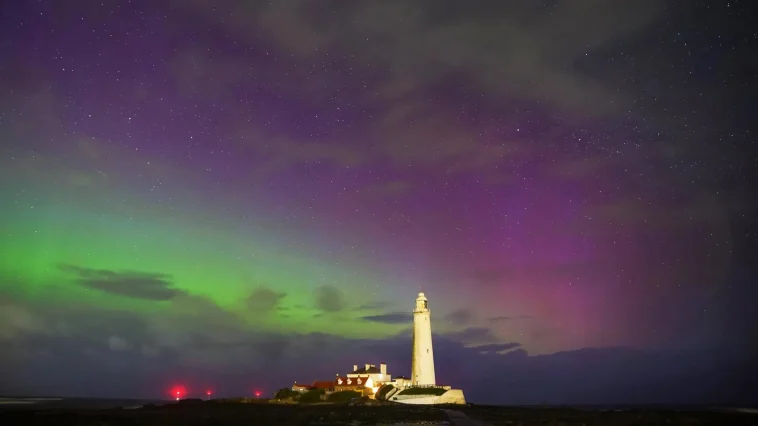
A fascinating celestial event is on the horizon, as space weather experts predict a G2-class geomagnetic storm will unfold overnight from Thursday, July 2, into Friday, July 3. This solar phenomenon holds the potential to paint the skies with breathtaking displays of the northern lights, offering a rare spectacle for observers across the northern United States. This forecast underscores the dynamic interplay between our Sun and Earth’s protective magnetosphere.
The National Oceanic and Atmospheric Administration (NOAA) forecasts peak activity to coincide with nightfall across North America on July 2. This anticipated aurora display stems from an Earth-directed, full-halo coronal mass ejection (CME) – a massive cloud of charged particles – that erupted from the Sun on June 30, following a powerful X-class solar flare.
Such a G2-class geomagnetic storm suggests that the aurora could become visible on the northern horizon in several U.S. states bordering Canada. Primarily, this includes regions across Montana, North Dakota, Minnesota, and northern Wisconsin. Intriguingly, there’s also a possibility for sightings further south in parts of the northern and lower Midwest states, expanding the potential audience for this natural light show.
However, optimal viewing conditions may face challenges. The extended daylight hours following last week’s summer solstice, coupled with the luminous presence of the waning Strawberry Moon in the southern sky after midnight, could somewhat diminish the aurora’s visibility. Nevertheless, dedicated skywatchers should remain vigilant.
What to Expect from This Aurora Display
While a G2-rated geomagnetic storm isn’t classified as a major, high-impact event for critical infrastructure, the predicted KP6 conditions are significant for aurora enthusiasts. The Kp-index, ranging from 0 to 9, quantifies geomagnetic activity, with a Kp6 indicating moderately strong conditions conducive to widespread aurora. These levels are very likely to bring visible northern lights to the far northern tier of the U.S., particularly near the Canadian border.
States with the highest probability of witnessing the aurora include the northern reaches of Washington, Idaho, Montana, North Dakota, South Dakota, Minnesota, Wisconsin, Michigan, and Maine. Furthermore, residents in Oregon, Wyoming, Nebraska, Iowa, Illinois, Indiana, Ohio, New York, Vermont, and New Hampshire might also catch a glimpse of the ethereal glow.
NOAA’s space weather experts affirm, “G1-G2 conditions are likely by 03 Jul due to the anticipated arrival of the 30 Jun CME associated with the X1.1 flare.” The UK Met Office’s Space Weather forecast corroborates this, noting that a coronal mass ejection (CME) arrival is anticipated early on July 3, which is expected to increase the potential for visible aurora. It is crucial for observers to remember that space weather is inherently dynamic, with forecasts subject to frequent revisions as new data becomes available.
For those eager to experience this spectacle, clear skies are paramount. Aurora watchers should seek out locations with minimal light pollution, position themselves facing north, and prepare to use long-exposure settings on their cameras or smartphones. It’s worth noting that camera sensors often capture faint aurora with vibrant colors long before the human eye can distinctly perceive them.
Real-Time Tracking for Optimal Viewing
In our technologically advanced age, real-time data is invaluable for predicting and observing transient phenomena like the aurora. To ascertain current visibility and receive up-to-the-minute information, several resources are available. NOAA’s 30-minute aurora forecast provides crucial insights, while dedicated mobile applications such as Aurora Now, My Aurora Forecast, or Glendale Aurora offer live solar wind data and immediate alerts.
The successful manifestation of an aurora display hinges significantly on the interplanetary magnetic field (IMF), particularly its Bz component. This crucial metric, often found within the aforementioned apps and on specialized space weather websites, dictates how readily solar energy can penetrate Earth’s magnetosphere. When the Bz component points northward, Earth’s magnetic field largely deflects the incoming solar particles. However, a sustained southward swing of Bz (typically −5 nT or stronger) indicates a magnetic reconnection, allowing plasma to stream into our atmosphere and trigger an imminent aurora. Understanding these dynamics empowers enthusiasts to make informed viewing decisions.
Unpacking the Science Behind the Northern Lights
The mesmerizing dance of the northern lights, or aurora borealis, is a direct consequence of the solar wind’s interaction with Earth. The solar wind, a continuous flow of charged particles emanating from the Sun, constantly bombards our planet’s magnetic field. While much of this stream is deflected, some particles are channeled along magnetic field lines towards the polar regions.
Upon entering Earth’s upper atmosphere, these high-energy particles collide with atoms of oxygen and nitrogen. These collisions excite the atmospheric gases, causing them to shed this excess energy in the form of light – creating the vibrant, shimmering curtains we know as the aurora. The specific colors observed, such as greens, reds, and purples, depend on the type of gas being excited and the altitude at which the collisions occur.
The current event is specifically linked to a Coronal Mass Ejection (CME). CMEs are massive clouds of solar plasma and magnetic field that are often, but not always, associated with solar flares. While solar flares release intense bursts of electromagnetic radiation that travel at the speed of light, CMEs are much slower, moving at speeds up to 1,900 miles (3,000 kilometers) per second. They typically take a few days to traverse the vast distance to Earth. When these CMEs are directed towards our planet, they can significantly disturb Earth’s magnetosphere, leading to geomagnetic storms and, consequently, pronounced aurora displays. A “halo CME,” as observed, signifies that the ejection is moving directly towards Earth, often leading to a stronger geomagnetic storm as it engulfs our planet.
Mastering Aurora Photography
Capturing the elusive beauty of the aurora requires patience and the right technique. While a mirrorless or DSLR camera offers ideal control (typically set to ISO 1600, a 2-10 second exposure, and an aperture of f/2.8), modern smartphones are increasingly capable of producing stunning results. For smartphone users, leveraging “Night Mode” or “Pro Mode” is essential.
Here are key tips for securing that perfect aurora shot:
- Utilize Your Main Lens: For optimal sharpness and detail, always opt for your smartphone’s primary lens rather than the ultra-wide angle.
- Ensure Stability: Camera shake is the enemy of long exposures. Secure your phone on a tripod or, at a minimum, brace it firmly on a stable surface such as a car roof, a wall, or a sturdy post.
- Shoot in RAW: If your smartphone supports RAW image capture, enable it. This format retains significantly more image data, providing greater flexibility and quality during post-editing.
- Embrace Long Exposures: Expect exposure times between five and ten seconds. Even faint glows that appear grayish or indistinct to the naked eye can transform into vivid greens, purples, or reds in a long-exposure photograph.
As we look to the night sky, this anticipated geomagnetic storm serves as a powerful reminder of the Sun’s profound influence on our planet. Beyond the breathtaking visual spectacle, such events underscore the critical importance of continuous space weather monitoring for our increasingly interconnected and technology-dependent world, from satellite communications to power grid stability.
Wishing you clear skies and wide eyes for this celestial phenomenon.
#AI #Tech #Innovation #Future #Science #Gadgets #Robotics #MachineLearning #DeepLearning #BigData #Metaverse #Cybersecurity
Artificial Intelligence, Cloud, Cybersecurity