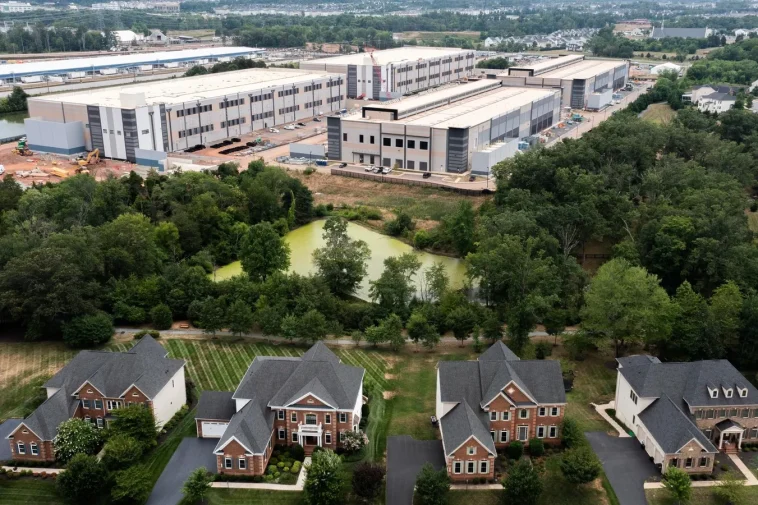
The Physical Reality of AI: Unmasking the Cloud’s Terrestrial Toll
The pervasive narrative of artificial intelligence often paints a picture of a weightless, ethereal “cloud,” a boundless digital realm where innovation flourishes without physical constraints. Yet, the stark reality is far more grounded: the future of AI is being forged in gravel, steel, and concrete. As tech giants accelerate their pursuit of virtual breakthroughs, they are inadvertently catalyzing the most resource-intensive industrial land grab seen in decades, demanding unprecedented volumes of land, electricity, and water.
This collision of boundless digital ambition and finite physical resources is fundamentally reshaping local utility grids, igniting civil disputes, and forcing a critical reevaluation of who ultimately bears the costs of this technological boom. The foundational bottlenecks of the AI era are not solely rooted in advanced chip design or algorithmic complexity, but in the tangible acquisition of prime real estate, staggering gigawatts of power, and billions of gallons of precious water.
Navigating the Inescapable AI Imperative
Despite these mounting challenges, AI is now deeply integrated into the fabric of the global economy. No leading nation, particularly the United States, can afford to sideline this transformative shift without risking its competitive edge and future prosperity. The critical choice before us is not whether to embrace AI, but rather how to strategically site its indispensable infrastructure, equitably distribute its costs, and establish sustainable terms for its operation.
The debate surrounding the AI boom is often framed as a false dichotomy between economic stagnation and ecological devastation. However, the pragmatic truth is that these data centers are not a temporary phenomenon; they are permanent fixtures of our digital landscape. The path forward demands a departure from unchecked expansion and a firm commitment to strict resource accountability. The illusion that these massive facilities can be built without consequence must end; the tech industry must internalize the true environmental and communal costs of its burgeoning physical footprint.
Northern Virginia: A Crucible of Data Center Demands
Northern Virginia stands as a potent testament to the scale of this boom, firmly established as the undisputed data center capital of the world. Within Loudoun and Prince William counties, over 300 colossal, windowless structures operate tirelessly, processing an estimated 70% of global internet traffic. This concentrated demand has pushed local transmission grids to their absolute limits, with tech companies now facing staggering wait times of up to seven years simply to connect to the power system.
The strain is no longer an invisible burden; it manifests in tangible conflicts. In central Virginia, generations of farmers and historic landowners are actively mobilizing against proposed infrastructure projects like the Valley Link Project. This ambitious, 115-mile, $1 billion transmission line is designed explicitly to funnel power to the exploding data center industry. Its proposed 165-foot towers threaten to bisect hallowed Civil War battlefields and irreplaceable agricultural landscapes, prompting conservationists to designate the corridor as one of the state’s most endangered historic places. This illustrates a growing tension between technological progress and the preservation of heritage and environment.
The Mounting Bill for Critical Resources
Recognizing the escalating strain, the Commonwealth of Virginia recently enacted a pioneering 1.1-cent-per-kilowatt-hour tax on data center electricity consumption. This groundbreaking levy was a direct response to the undeniable fact that the sheer volume of power consumed by these servers threatened to inflate residential utility bills by hundreds of dollars annually, subsidizing new grid infrastructure. Far from a symbolic gesture, this tax represents a crucial regulatory precedent, allowing essential digital infrastructure to flourish while compelling tech companies to bear the authentic financial burden they impose on local communities. This move highlights a growing global trend towards making large-scale energy consumers accountable for their grid impact.
Debunking the Water Usage Myth
Defenders of the data center industry, often represented by influential trade groups such as the Data Center Coalition, frequently attempt to mitigate environmental concerns by asserting that a single data center consumes significantly less water annually than a local golf course or a commercial agricultural farm.
However, this comparison relies on a fundamentally misleading statistical sleight of hand. Agricultural operations and golf courses typically utilize untreated “green water,” drawn from local rivers or private wells, which is then dispersed over open soil, allowing for natural filtration and replenishment into the groundwater system. Conversely, data centers demand highly concentrated, meticulously treated, potable municipal water—the very same clean water that supplies household kitchen taps and sustains communities.
In Northern Virginia alone, the potable water consumption by data centers more than doubled between 2019 and 2023, reaching nearly 2 billion gallons annually. In water-stressed regions like Texas, this demand is projected to soar to an astronomical 399 billion gallons by 2030. By drawing parallels with golf courses, tech giants effectively obscure a vital distinction: they are actively depleting the finite supply of drinkable, treated water critical for the communities hosting them. As UC Riverside professor Shaolei Ren aptly explains, AI cooling predominantly relies on “blue water”—freshwater from rivers and lakes essential for human consumption. Once evaporated by a data center, this precious resource is irrecoverably lost to the local community, underscoring the urgent need for sustainable cooling solutions that prioritize recycling and water-agnostic technologies.
The Deepening Electrical Grid Crisis
The bottleneck on the electrical grid presents an even more critical challenge. By the close of this year, global data center energy consumption is projected to near an astounding 1,050 TWh, a figure equivalent to the combined electricity usage of entire nations like Germany and France.
While tech behemoths such as Microsoft, Google, and Meta often publicize their substantial investments in renewable energy sources like wind and solar, these claims often overlook the fundamental physics of grid operation. Wind and solar power are inherently intermittent, generating electricity only when weather conditions are favorable. In contrast, an AI data center demands a constant, uninterrupted 24/7 stream of “baseload” electricity. When the wind ceases or the sun sets, a data center’s intricate algorithms cannot simply pause their operations.
Given that large-scale, cost-effective battery storage solutions are not yet universally scalable, regional utilities are compelled to backstop these renewable systems with “firm” power sources. To avert disruptive blackouts, utilities are often forced to prolong the operation of aging coal plants or construct new natural gas peaker plants. A tech company’s virtual “green” energy certificate does little to alter the physical reality on the ground: their relentless, round-the-clock power demand is inadvertently locking fossil fuel generation into local grids for decades to come, thereby undermining broader decarbonization efforts.
This escalating power demand does not occur in isolation. Every megawatt a data center draws from a constrained grid is a megawatt less available for essential societal needs—a new manufacturing facility, critical housing developments, or the expansion of a vital hospital. The American economy cannot sustainably protect one sector by allowing it to cannibalize the power grid at the detriment of domestic manufacturing, housing, and commercial growth. We must confront the structural macroeconomic tradeoffs inherent in this intensifying resource competition.
This profound physical reality is precipitating a necessary reckoning. Tech companies are increasingly realizing that while software can be written and deployed instantaneously, the complex processes of pouring concrete, obtaining permits for power lines, and securing reliable energy sources are far more stubborn and time-consuming. Rather than viewing this as a zero-sum war of attrition, the technology sector must relinquish the illusion of “free ride” growth, internalize these massive external costs, and adapt to the finite physical limitations of the systems that host its innovation.
The environmental implications are stark. As Luke Metzger, Executive Director of Environment Texas, revealed, “There are an estimated 130 new gas-powered power plants that have been proposed for Texas, in part to meet this demand for data centers, and if they’re all built, that’s going to have as much climate pollution as 27 million cars.” This alarming projection is in addition to the billions of gallons of water a single data center consumes, compounding the environmental burden.
America faces a dual imperative: it cannot afford to fall behind in the global AI race, nor can it afford to silently bear the escalating costs of AI’s physical footprint. The profound irony of the age of artificial intelligence is that the most advanced digital tools, promising to reshape our future, remain inextricably bound by terrestrial limitations. The industry that envisions and builds tomorrow must now squarely confront and responsibly answer to the very ground upon which it stands.
#TrendingNow #Innovation #TechNews #DailyInspiration #Mindfulness #TravelGoals #FitnessMotivation #HealthyLiving #Foodie #FashionStyle #ArtLovers #Bookworm
Artificial Intelligence, Cloud, Generative AI